Living in Honduras and Guatemala is sometimes hard, mostly fun but never boring. Here some of my musings on life in this colourful part of the world where you can always expect the unexpected. Hence Serendipity, the gift of finding without seeking…

Monday, April 9, 2012

Truths and Untruths about the Maya Calendars


There are, in my opinion, few things I know a little about that are as complicated as the Maya calendars.

I definitely don’t have a knack for math, and I guess that’s why. I’m only just able to understand why the period of 52 years is sacred to the Maya. The reason is that the Calendar Round is repeated every 52 years (=18,980 days). A calendar Round is a combination of a Tzolk’in date and a Haab date. Tzolk’in is the lunar calendar of 260 days, while Haab is a solar calendar of 365 days.
Are you with me so far?

This duration of 52 years can be explained because the least common multiple of 260 and 365 is 18,890 which equals 73 Tzolk’in years or 52 Haab years.

Obviously I copied this information from Wikipedia, because my mind can barely grasp a concept such as least common multiple. What baffles me more than anything is that the Maya figured this out without the use of Wikipedia!!!

So please don’t ask me anything about the Maya calendars.

However, what I can tell you plenty about is the symbols used in the two calendars mentioned above. I love their glyphs and use them a lot (A LOT) in my artwork, shamelessly riding the wave of the 2012 hype (hey, a girl gotta eat!!!). And I’m not the only one. You just Google images for “maya calendar” and you’ll find about 11,900,000. (Don’t be fooled by Google’s advice: “Did you mean: mayan calendar”, because “Mayan” refers to the Maya languages, while “Maya” is the adverb for anything else that is Maya!)

The funny thing is that about half of these images don’t show the Maya calendar, but the Aztec calendar. Aztec is a club Snooki and friends like to frequent in Jershey Shore, but the name also refers to a certain ethnic group from Central Mexico that dominated large parts of Mesoamerica from the 14th to the 16th century. They knew the Maya, they even conquered a few Maya cities here and there, but they are not the same as the Maya. The Aztecs are to the Maya as the Americans are to Canadians. Or the Belgians to the Dutch.

Aztec! Aztec! Aztec! Aztec Calendar Stone

The Aztec “stole” the Maya calendar and made it their own. The names and symbols are different, but the system is basically the same as the Maya Tzolk’in and Haab calendars. The big difference is that the Maya had another calendar that was widely used, the Long Count, designed especially for referring to long periods of time. Whereas the Aztec had to start counting all over after every 52 years, the Maya continued counting since their point zero, August 11, 3114 BC, and will continue to count for ever more. One of those larger periods, the 13th bak’tun, ends on December 21, 2012. The Mayas did not started their counting at Day Zero, but at 13.0.0.0.0. Since the Long Count too is a cyclical calendar, on December 21, after 5125 years, it will be at 13.0.0.0.0 again, and a new round will start. Not the end of the world, simply the beginning of a new round of 13 bak’tuns. 
Bottom line, it is very silly to use an image of a 52 year-long Aztec calendar while referring to the “Maya prophecy that predicts the end of the world”. It’s actually quite funny how many “Maya experts” are using an image of the Aztec calendar for publicity purposes. 
Maya Calendar Stone with year bearer???

The second important thing I learned about the Maya calendars is that they work together as if interlaced together as different sized wheels. This is a great way to visualize how they work. However, the Maya calendars are, as far as I know, NEVER EVER depicted like that on any ancient Maya monument, mural or painted ceramics. The circular image of the Maya calendar (either with the Tzolk’in day glyphs or Haab month glyphs) is very popular and sells well as pendant, coaster, T-shirt design and mouse pad. You see it everywhere, with in the middle a miserable looking Maya carrying a day glyph on hs back. I guess this refers to the year bearer. The year bearer is one of four Tzolk’in days that happen to be the first of every Haab year. They quite literally carry that day on their back. But I have never seen an actual image of it. It’s most likely that it is the creation of a smart artisan and that his design has been copied over and over, turning it into something “authentic Maya”.
The New Original Ancient Maya Calendar!!!
I figured I could do the same thing, so I stole the idea of a circle with all the Tzolk’in glyphs but instead of the year bearer, I put the glyph for birth in the middle, referring to the “birth of a new era of the Long Count”, or something. So if this goes viral and becomes the new ancient Maya calendar, you know where it comes from! (Wink!)

And to end those rambling thoughts on the Maya calendars, let me remind you that for only $5 I’ll design you your own Tzolk’in day glyph! It will protect you till the End of Time, guaranteed!!!


Sunday, April 8, 2012

I hate Semana Santa!

Oropendola nests at the Copán River
I’m not sure whether it’s a deeply rooted cultural difference or it’s just me, but I HATE Semana Santa! I don’t particularly dislike the religious tradition of sawdust carpets. They’re actually quite beautiful and a true community effort. I also don’t mind the processions and I do enjoy the beautiful set-up of the different stations of the Calvario of Jesus. I tend to complain about the oppressing April heat, but hey, that’s one of the main reasons for my being here in the first place. I prefer the town in its normal tranquillity, without the invasion of Salvadorian tourists, but I can live with it. But what I CANNOT STAND is being anywhere near the river these days.

I love the Copán River. For almost every day of the last fifteen years, I’ve been walking along, to, or through the river with my dog(s). I love the river when the water is crystal clear and alive with tadpoles. I love it when it’s chocolate brown and roaring angrily after the first tropical downpours. I love the river at the peep of dawn and in the soft embrace of the afternoon sun. I love three-dimensional sound of the flock of oropendolas that have their nests hanging high above the river’s edge. I love the river’s steep cliffs, its rocky beach, its shady edge.

But all that is now, at least temporarily, history.
While Salvadorian tourists have taken over the town, the Copanecos have all gone to the river. And with them, their cars, stereos, barbecues, mattresses, hammocks, pillows, inflatable pools, pets, baby cribs, chairs, tables and tons of kids and food and disposable cups, plates, cutlery and bags. And whereas for some people it might be fun to sit next to your neighbour’s car on a tiny bit of rocky beach with your feet in the three inches of highly contaminated water with music blaring from three different sides, it’s isn’t mine. But still, cada loco con su tema.  But what really bothers me is what is left behind when the sun goes down. Mile after mile, there’s trash just everywhere.

So, after fifteen years of living in Honduras I still don’t understand this. Is this a typical Honduran thing, or does it happen elsewhere too? Why, if you’re coming by car in the first place, can’t you just take your trash back home with you?
Why would you want to sit on a beach littered with yesterday’s trash?

Can’t wait for nature to take over again…

Thursday, March 22, 2012

Leaving Honduras

This is quite a moment... I have known for months, almost years...
But now it is Facebook Official.

I'm leaving Honduras.

To read more about why, when, how, etc., see my new blog, Painting the way!

And oh, please order some art work, will ya?

Thanks

Sunday, March 18, 2012

Murder by numbers


A couple of months ago, Honduras made the news with the disgraceful feat of having the highest murder rate in the world. It will probably scare off some tourists who were planning to vacation in Honduras, but if you live here, those numbers don’t mean an awful lot. Of course, everybody knows that the situation is bad and much worse than a few years ago. But still, the violence is very much restricted to certain neighbourhoods in the big cities. Copán Ruinas is still, at least relatively, a very peaceful town.

But those numbers actually do mean something.
I grew up in the centre of Amsterdam and for years I lived in a neighbourhood that was at the time considered to be the most problematic. I’ve seen my share of drug abuse and petty crime, but I can’t say that I know of anyone being murdered. Not a single person.  I don’t think I know any second-degree victims of violence either. But that’s not so strange. Amsterdam has almost a million inhabitants. In 2011, of that entire population, only 19 people died a violent death.

Copán Ruinas has about 10,000 inhabitants. And I personally know a lot of people who got killed. Seriously, since I started thinking about it, I’ve been making a mental list of victims, and the list is long. I don’t think anybody is counting, but for 2011, the list might easily be twice as long as the one for Amsterdam. Some of the people on my list were known to be mixed up in things they shouldn’t have been involved in, which explains their violent death, although it doesn’t justify it. But most of the victims were normal people, minding their business, trying to make the best out of life.

I think there are very few families in Honduras that haven‘t been somehow touched by violence. So many people have mourned the loss of a loved one and know the feeling of anger, frustration and sadness. What an impact that must have on family life, on children, on future generations! And that while the violence itself keeps on spreading like an infectious disease.

Maybe it is not so good to see violence as an entity. Because in the end, violence is not an uncontrollable alien factor, but us humans who are committing all that violence. And we are the only ones to stop it too.

Let’s please put an end to it…

This one’s to Abner, beloved son, cousin, brother, uncle and friend of so many

Saturday, March 17, 2012

Rules of flirtation

To keep things uncomplicated, this post is about heterosexual man-to-woman flirting only.

In Honduras men ALWAYS flirt with ANY woman. Whether it is a serious attempt to get into her panties or a half-assed effort to get her attention, Man will hit on Woman, Always and Anywhere. It doesn’t matter how old or attractive the woman in question is, or whether she’s obviously already in the company of a male member of humankind. Man plus Woman equals: let’s give it a try.

I don’t know what kind of unwritten machismo rule states that this needs to be the case (I’ve even seen gay guys hitting on women, just for the heck of it), just that it can lead to very uncomfortable situations. For women, that is. In their defence, men in Honduras are not touchy-touchy, so usually a “No, gracias” is sufficient to keep men at bay.

What I don’t understand is why men flirt the way they do. I mean, I know the objective, but don’t they know there are better ways to get a woman into their bed? Do they really think we like to hear tsssschuh- tsssschuh- tsssschuh on the street, or being whistled at?
Do obese men think that leaning against a wall, one leg bent, T-shirt folded upward over the chest, one hand rubbing a fat belly while groping their balls with the other, IS A PRETTY SIGHT TO WOMEN?????
Do men really think it’s attractive when they noisily clear their throat of phlegm and then spit the slimy stuff out on the street right in front of you, before they address you with a sexy “Hi baby…”?
Isn’t the officer aware that when I go to the police station to report a robbery, I’m not quite in the mood for flirtation?
Why doesn’t the kid at the market understand I’m much more interested in him putting bananas in my bag, then the banana in his pants?
Why keep on hitting on me when I have just lied that I am married and have a ring to prove it? (Most alarming answer: “That’s okay… I can come by when your husband is at work!”)

Another thing that baffles me is that apparently flirting doesn’t have to be age appropriate. Me myself, I’m not that young anymore, but regularly get whistled at or commented upon by old guys, obviously, but also by young men that could be my kids, age-wise. My grandchildren, even, if we take in account the young age women here usually have their first child. I find that quite disconcerting, especially if it goes beyond flirting. Not once but twice in the last few years, love was declared to me by a fifteen-year old and that completely freaked me out. In both cases I did my very best to tell the guy off without hurting his feelings too much (it was a brave thing to confess after all, if not illegal!). “Oh, okay”, each one of them said and that was the end of it, for them. I guess they just had to try and to be rejected was no big deal. However, the whole thing left me deeply disturbed.

I also find it troubling to meet ex-students of mine in a bar who start to flirt with me. Ex students from when I was a kindergarten teacher!!! That was fifteen years ago, so those kids are about twenty know, at least legally adults, but since I’m also fifteen years older than I was then, I guess you can see why this is slightly upsetting. Especially if they come up to you with a seductive smile and call me “Miss”.

Yesterday I saw that old man again who once offered to visit me while my husband is at work. He’s been flirting with me forever (“to” would be a better preposition in this case than “with”), but you’ve got to give him credit: the guy is old (could be my great-grandfather!), toothless, unshaven and he stinks, but never gives up. But yesterday for once he actually didn’t flirt with me, but said:
“I see married life has been good to you!”
Puzzled, I asked him why.
“Because you look fat!”

I felt like killing him after all.


Thursday, March 8, 2012

Is machismo women’s business?


"But of course women can be blamed for machismo!" exclaims María Eugenia de la Vega. "Look how they treat their children: a crying girl is comforted, but a little boy who cries gets scolded because real men don't cry. A boy squatting down to pee is told that he shouldn’t, he’s not a girl! And you should see how sons are being served like princes at dinnertime, often by their own sisters!"

If there’s someone who knows about machismo, it is María Eugenia de la Vega, a woman from Chile with fifteen years of experience in the gender field, now working for the United Nations in Tegucigalpa, Honduras. She is joined by her namesake, María Eugenia Dalorso, an equally strong woman who two years ago left her homeland Argentina because of the economic crisis. Destiny led her to Honduras, where both she and her husband could get a good job, he as a doctor, she as a company consultant.
"Even in Argentina, where the culture is not as
Latino as in Honduras, machismo reigns. At every level. My father was not exactly macho. On the contrary. He was director of a thriving company with quite some employees. I can not remember him ever insulting or humiliating anyone, as typical bosses often do. It was my mother who manipulated and threatened the workers that they better follow instructions, because if my father would hear, he would get mad and then…
For the world she painted my father off as a brute and a tyrant, while he was just a friendly chubby guy. But for some reason that image didn’t fit in the picture of how my mom thought things were supposed to be.”

As foreigners they agree that the situation for women in Honduras is many times worse than in their own countries of origin.
De la Vega explains: "There is a lot of abuse within the family here, both sexual and physical. It is so bad that many men are convinced that women actually like it to be beaten up, and women think it is normal."
"Another thing that strikes me," says Dalorso, "is that there is little solidarity among women. I see this a lot in my work among highly educated women. Once they figure you might form even the slightest threat, they turn into vicious monsters that’ll do anything to overturn you. I'd rather work with men. Although their comments drive me crazy: ‘But why do you work in the first place? Doesn’t your husband have a good job?’”

"And to continue about men," says de la Vega, "of course, the problem of machismo is the behaviour of the men themselves. But you can hardly blame them: they really don’t know any better! They get it spoon-fed since they’re little baby boys! But therein also lays the solution to the problem, although it is not short-term: education and information. I've conducted workshops where the men took over the role of women. They had to cook, clean, and take care of the children. After three days they were completely exhausted and forever cured of the idea that the women stay home all day to do less than nothing. That acknowledgment is very important to women. Since they don’t get paid, they often feel that domestic work has little value. That is one of the first things I try to teach them: the importance of the role they play in everyday life. It's hard enough as it is, in a country where water often doesn’t come from a faucet, but from a stream a mile away. Dinner doesn’t come from a package bought in the supermarket. There’ll only be tortillas on the table if the corn is sorted, dried and grounded. Not to mention the herd of small kids that follow their mother everywhere."

Rosalila Villela is a beautiful woman with a round face and an infectious laugh. She is 37 years old, married for 15 years and mother of two daughters of 13 and 5 years. Her family came to the town of Copán Ruinas two generations ago, looking for a better future than their small mountain village could offer. Rosalila now cooks and cleans at a restaurant. If you hear her talk to her colleagues, you’d think she is very progressive in her thinking. She addresses a male colleague with names that are not considered quite decent. And she doesn’t like machismo. Why?
"Because it’s so much work for us women: his laundry needs to be done, the food must be on the table on time. Yes, he is the absolute master of the house. Don’t get me wrong, I have a good guy. He doesn’t hit me and we share all costs in the household. If he has work, that is, because he has no permanent job. That is why I work too. And I can do so, because my oldest daughter takes care of her sister and makes food for my husband. That would have been different if I would have had sons instead. I wouldn’t be able work. What? My sons preparing lunch for my husband?" A heartily laugh. "Well, why not. But you would need to teach them from the very beginning, because once big, they’re hard to change. Machismo is so much part of our culture here. My husband never ever picks up a broom. ‘I'm not gay,’ he says.

I think the situation with other families is pretty similar. I actually don’t know. Outside my job I have few friends. I just don’t have the time for it. In the morning I clean peoples’ houses. At one o'clock my shift starts in the restaurant, until nine-thirty at night. But I have a lot of support from my family. We all live together in the same house and everyone watches each other’s children. If there is a problem, I discuss it with my mother, my sisters or sisters in law. It's better that way, because if you tell someone from outside the family, things often get blown up. At work it’s different. That’s a place where I joke and gossip.

I think machismo can be solved through education. Mothers should be more involved in their sons’ education. In general, boys have too much freedom. That’s why you see them hanging around, doing drugs and alcohol.

If we would have enough money, I'd rather stay home than work. To take care of my daughters, but also to keep an eye on my husband. Many men cheat on their wives. That's because the wives are at work, so the men just hang around. And one thing leads to the other. That’s why I don’t want my oldest daughter hanging around on the streets. I send her out to run errands sometimes, but I don’t want her to linger. For that reason I took her out of school, last year. The high school is located just out of town and I had no control over her. I heard she ran around with boys, and I didn’t like that. So I had her stay home. But I also wanted her to study and have a better future than I have. So now she’s back in school. My youngest daughter started kindergarten this year. Yes, I surely hope that there is little less machismo in their future. That’s why I always tell them: don’t let the boys get to you!"

Suyapa Mel
éndez was still very young when her father abandoned her family for another woman. Her mother stood all alone for the care of Suyapa and her younger brother and sister. When Suyapa finished elementary school, she started working to increase the meagre income that her mother was able to make by cooking for other people. Suyapa sold Maya figurines and cheap necklaces at the entrance of the archaeological park of Copán. Later she worked as a waitress in a restaurant and in her spare time she started a radio course to get her middle school diploma, which she obtained after six years. At age twenty-one, she started high school in order to get a diploma that would allow her to continue studying at university, with a specialty in business administration. There was now less financial pressure because her younger sister had begun to contribute to the family income too and her mother, Doña Alicia, had found a new love in her life, even though soon that love turned out to be more costly than beneficiary.  

Suyapa' greatest wish was to study at university; a dream that came true when, thanks to her own efforts and perseverance, she obtained a one-year scholarship for a private Catholic college in Santa Rosa de Copán. A new world opened for her.
"There’re more girls than guys studying here, and there is hardly any discrimination between the sexes, let alone machismo. Things are completely different at home. My mother barely has any freedom. She can never go out with us, because she always must be home in time to prepare dinner for her husband, or to iron his clothes or whatever. He does nothing all day. I mean, really nothing. If he needs something, he sends someone out on an errand. He only gets off the couch to go out drinking.  But most of the time, his friends come over to our place to drink. My mother just accepts it all. I told her a thousand times that she should go out with us every once in a while, that for once in his life he can serve his food himself. But my mom is so used to the system, too, she just can’t do it. In that respect, my sister and I are much freer. We help where needed, but otherwise we do what we want to and won’t let a man order us around. But at the same time, my mother is also quite emancipated. Although she herself finds it hard to say no, she raised all three of us the same way. My brother must pick up his own socks; just like me and my sister. I often tell him that he shouldn’t be like his father, that irresponsible asshole.

Although I had never planned to submit myself to any man in the first place, university has been a huge revelation. Even the priests are against machismo and say that the man might be the head of the family, but the woman is his compañera, and both have equal rights.
There are so many strong, professional female students here! There is considerable solidarity among the students and not as much rivalry and envy as I had expected. Women are more responsible and have a tremendous fighting spirit. I think that is why there are more women than men studying here. You can find prove of this theory at law school: it is the easiest department of the entire university and there you will find mostly men!
Personally I feel I have the same opportunities as a man and that’s how I live my live. There is much you can do about it, just don’t accept that macho nonsense. I wish more women would discover that secret!"

"Again, the answer is information, education and the way you raise your children." says María de la Vega. "Especially in rural areas where it is difficult to discuss gender issues. It makes no sense to drive a wedge between men and women. Women are women, men are men, and we simply can not live without each other. But it wouldn’t hurt is to have a little more respect for each other."

Carin Steen, August 2004
This article appeared in Dutch in La Chispa, Magazine on Latin America (Holland, Octobre, 2004)
Editing of Dutch version: Maja Haanskorf
For privacy reasons, the names of some people have been changed

Wednesday, March 7, 2012

I am special!


Tigo thinks I’m special! And not every once in a while, but almost every day! And if Tigo doesn’t tell me I’m special, it notifies me that I’m very close to winning no less than three KIA cars!
Or have “limitless nights” for half price!  Or activate backtones and ringtones and keypad tones and whatever tones for whatever great price!  Triple saldo hoy, just because I’m special!!!

If being boring, mediocre and unremarkable would mean I wouldn’t receive anymore text messages from Tigo, I’d gladly be so. But I am special, says Tigo, and I have to suffer.

When I had just bought my phone, I received an evangelical message everyday, sometimes at very ungodly hours in the morning. I was able to block those, but my block list was quickly full. Fortunately, my phone, although purchased at an official Tigo store, was actually a Digicel phone that had been “upgraded” to Tigo. I don’t care much for one or the other, but the advantage was that I could at least block some of Tigo’s numbers they use to send out text messages, a feature that Tigo doesn’t allow on its own phones. So I’ve been able to block a whole bunch of annoying daily message, but unfortunately not all.

But things could be worse. A friend of mine receives a joke every day. Quite annoying, but the real problem is that she gets charged for it!!! She has been back to the store, called Customers Service many a time, but to no avail. She still receives a joke a day. And not good ones either.
Maybe she’s just not special enough.

Sunday, March 4, 2012

I am Maya!


In case you missed it. "I am Maya!", the multi-lingual colouring book I wrote/illustrated last year for MACHI / InHerit, based on the colouring book we've been using to teach Honduran, Mexican, Guatemalan and Belizean children about Maya culture. By purchasing this book, you support MACHI's projects. Only $ 9, for sale at Amazon! See:  ¡Soy Maya!

Thursday, March 1, 2012

Things I don’t understand in Honduras: Pajillas


If you order a fresco, you usually get it served with a pajilla or straw. Thing is, the straw is about an inch shorter than the bottle is tall. So when you stop drinking, the straw falls into the bottle and it’s hard to get it out again.

Straws are not expensive. They’re actually really cheap, every brand (all of them too short) I’ve ever seen. I have no idea how they are made, but I can’t imagine it’s a big deal, considering their low cost. So why can’t they make straws a little bit longer? Who decides on the length of a straw anyways? Are there any straw regulations?

I don’t like the hassle of pulling a straw out of a pop bottle with my pinkie. I guess that’s why I prefer beer…

Wednesday, February 29, 2012

Things I love in Honduras: Doña Berta’s Pulpería


Pulperías come in every size. It’s interesting to think of when exactly a neighbourhood store becomes a pulpería: if a housewife sells batteries, chips, consommé and matches form her living room, is that a real pulpería or not? Or does it need to provide toilet paper, lard, eggs and 2 litre Coke bottles too?
And where does it end? Is my favourite store, Doña Berta´s, a pulpería or a small supermarket?
The store is actually called “Comercial Cruz Bueso”, but everybody (except for the tourists) refers to it as “Doña Berta’s. Doña Berta sells everything. And if she doesn’t, you bet you won’t be able to find it elsewhere in town. She sells, of course, the basics such as rice, sugar, lard, milk products, cereals, cookies, chips and soft drinks. But also pills and syrups in every possible colour and flavour; fabrics, sombreros, diapers, cowboy boots, underwear, sowing supplies and rat poison. Doña Berta offers mattresses, lamps, chips, school supplies and bullets. Food colouring, beer, picture frames and rubber flip -flops. Gift bags, envelops, deodorants, soap, lice combs, coffee makers, pots, pans, knives, make-up, cat food, snow cones and fire water. And wait for the seasonal ofertas: artificial Christmas trees in every imaginable size and shape from October on. Fireworks for New Year’s Eve and other occasions. And for Easter weekend: an enormous assortment of inflatable devices, displayed on the sidewalk, ceiling and any other spot where something else can be crammed in.
Every once in a while I permit myself the time to get lost at Doña Berta´s, savouring the smell of the rubber work boots in the far end corner, or the cinnamon bought in bulk from a campesino. I can spend hours at the store and always find something I’d never noticed before.
I love how the neighbours come by early in the morning in their pyjamas. How the women from the villages up north dress up to come down town to go shopping at Doña Berta’s. How in the afternoons people gather around the cash register to exchange the latest gossip. Doña Berta’s pulpería is the centre of the world. It’s one of my favourite places in Copán.

Tuesday, February 28, 2012

Things I hate in Honduras: Milk in a bag


It might not seem to be a big grievance, but since it’s a frequently reoccurring one, it actually is.
Milk in a bag.
Why, oh why?
It’s impossible to keep it in the fridge without spilling. It’s not easy to pour from a full bag of milk either. And there is no way you can drink straight out of the bag. Not to mention that they often leak, all the way from the store to your fridge.

I hate milk in a bag.

Not long after I came to live in Honduras, about fifteen years ago, I visited a friend in Tegucigalpa. She had a special milk container. It was just an oval sized pitcher, slightly bigger than a bag of milk, with a handle on one side. So you put the bag in the pitcher, cut off a corner and pour. Perfect! Since then, I’ve never stopped looking for a similar “milk pitcher”. To no avail. Although the country is inundated by all kinds of plastic pots, tubs, buckets and other brightly coloured vessels from China, the milk container seems to be extinct. So my milk bags keep slouching over in the door of my fridge, leaking its contents over jars of olives and pearl onions onto the floor. My dog doesn’t mind, but I do. And there’re not a lot of fun crafts to do either, with an empty milk bag…

And another nuisance, related to the topic: the Christmas packaging. Every year, the two big milk companies, Sula and Leyde, come out with a Christmas edition of their milk bag, usually with a red coated reindeer, some bells and snowflakes. But they always print way too many of those bags, so we drink “Christmas Milk” way into February, when summer has already started. Great publicity.

I’d never thought that a simple milk carton could be a subject of nostalgia…

Monday, February 20, 2012

In the beginning there was fire


 I love it when a solution presents itself in my dreams…

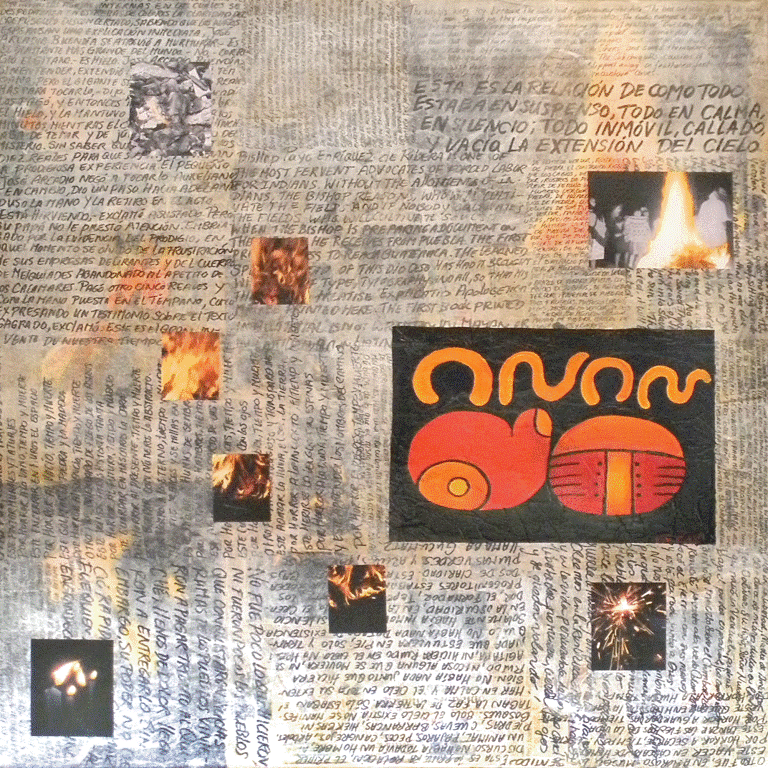
In 2006 I made this painting /collage for an exhibition we had in our gallery at the time, in Copán Ruinas. The canvas measures 135 x 135cm and consists of a thick layer of Honduran and Guatemalan newspaper, paint, photos and writing. The texts are from the Popol Vuh (the creation of the world) and several other Latin American novels and poems (by Gabriel García Márquez, Eduardo Galeano, Rubén Darío and others), all having to do with the creation of the world or the power of fire as an element of development as well as a destructive power. The work is a collaboration between Ronald Reinds, Lise Winters and me. Lise provided the photos of a bonfire in an indigenous community in Guatemala. Just below the middle of the right half, I left open a white rectangle on which Ronald projected his short 8mm film of himself reading a newspaper that burst into flames. We presented the work as an installation during the inauguration, with a mural of flames painted on the wall behind it and embers, ashes and burned paper underneath it.

When the exhibition made room for a new one, the painting ended up in my office. I never even tried to sell it because it is awkwardly big and heavy and besides, without Ronald’s projection, there was this graceless white rectangle on the right. For years I planned to “finish” the work, but never came up with the right solution. Once I thought of filling the space up with an assemblage of burned embers and cinders. I went out of the way to find pieces of the right size of burnt wood, but for some reason never got around to glue them on. 

A few days ago, the work appeared in my dream among many other completely inexplicable images. In my dream it was completely finished... The white of the rectangle was now black, and on it was a Maya glyph representing fire painted in bright yellow, orange and reds.

Perfect!

So, six years after creating this work, I finally finished it. It turned out exactly the way it looked like in my dream…

Ronald Reinds: http://www.beeldresearcher.tv/ 
Lise Winters  http://www.lisewinters.com/

Thursday, February 16, 2012

Another ghastly record for Honduras

 Honduras made the international news for yet another horrific record: the world's deadliest prison fire in a century. On the night of February 14th, Valentine’s Day, a fire broke out in a prison in the city of Comayagua. The inmates were trapped and 358 were burned to death.
I find this news incredibly disturbing for various reasons. First of all because I can’t think of anything worse than being trapped in a burning building. Secondly, because this should have been prevented. A fire in a prison is nothing new in Honduras. In 2004, more than a hundred inmates died during a fire in the penitentiary in San Pedro Sula. The taxi driver who broke the news to me shrugged his shoulders and said: “Oh, this happens every year….” It does. The prisons are overcrowded and understaffed. The situation is medieval and far from corrective. This is no news at all. With a 250% occupancy of most prisons, it is no surprise that this has happened, whether it was caused by a short circuit or by an inmate setting fire to his mattress. But the fact that it is no surprise doesn’t make it less of a tragedy.
What I find most disturbing of all is the reaction of the people. The press is all over the case, of course, and newspapers brought out extra editions covering the fire with horrendous pictures of carbonized bodies. People all over the country were shocked. But another reaction also surfaces: “Good riddance”. If you read La Prensa or any other Honduran newspaper on-line, you’ll find some severe reactions from the public: “I wish this would happen in every prison”, or “They deserved it…”, and: “A good way to get rid of delinquency…”
A few people express their condolences to the family members of the perished inmates, others blame it on bad politics, but most people seem to think these prisoners had it coming.
That doesn’t surprise me, but it does shock me. I can understand the feeling of satisfaction for another man’s tragedy, especially living in a country where there is so much violence, deliquency and so little justice. But thinking “good riddance” also shows a lack of respect and humanity that so typically characterizes many of the delinquents themselves.
About half of the perished prisoners never had been charged, let alone convicted. For certain, not a single prisoner was sentenced to death, since capital punishment does not exist in Honduras. Not to mention burning to death…
Thinking that this tragedy is a solution is just as much of a tragedy.

Tuesday, February 14, 2012

Diseases in Honduras

You can find some interesting diseases and illnesses in Honduras, some real, some infectious, some imaginary, some serious, some not. 

My thirteen year old sweep-help told me this:
“When my mom was pregnant with me, she was really sick. She had cancer. Stomach cancer. Sometimes it was so bad, she could feel the cancer moving around through her body. She could feel it move in her chest and in her shoulders. Sometimes, the cancer even made her feet wiggle. But fortunately the neighbours came by every day and prayed for her. That cured her. Now she’s fine.”

Also very intriguing, told by yet another one of my little helpers, Saudi, age 13:
“Women with babies have to be really careful not to breastfeed in bed. Because there’s a snake that tries to drink all the milk. I know of a woman it happened to. Her baby son was really skinny and eventually died. What happened was that the snake lived under the bed and at night it would suck the milk from the nipple while it put its tail in the child‘s mouth, so it wouldn’t cry. The baby couldn’t drink any milk and died. The mom got a fever and died too.
This happens a lot.”

Saturday, February 11, 2012

Some thoughts on sweeping


Since last week I pay one of the neighbourhood kids to sweep the street in front of my house every Saturday morning, because if there’s one thing I absolutely hate it’s sweeping the street. It’s not so much the sweeping nor is it the public humiliation of standing in plain view in the dust. I do sweep tons (I’m one of the rare foreigners in Honduras without domestic help) and I don’t care what people think of me, so that’s not it.  I just don’t like it and for that reason never do it, which makes me feel guilty towards the neighbour on the right who sweeps the sidewalk every, if not twice a day. She also devoutly sprinkles the street with water so the dust settles down. The neighbours on the left are way worse than I am, so at least that’s a comfort.
Sweeping is such a part of daily life here. Every morning around seven, when the kids are off to school and men off to work, the housewives of Copán swarm out of their houses armed with brooms and often still in their night attire. And then they sweep. Of course it’s a social event too, in which the latest news and gossip is being exchanged. Not long after, the municipal ladies come by and sweep the street yet again.
Does that mean that Copán is the tidiest place on earth?
Unfortunately not.
It’s true that a lot of the dust on the streets is just sand or whatever dust is made of. And that the street dogs open trash bags and drag garbage all over. But a lot of it is trash is deposited by people of every age and gender, shamelessly dropped wherever it drops, 24 hours a day. So my reasonably logic mind thinks: if mothers teach their children not to throw garbage on the street (and keep their dogs at home), there will be much less to sweep up. The women will save up dozens of hours a year and can dedicate that time to do something else.
But when I proposed this to a few women, they looked at me as if I were crazy. So I gave in and now pay Chepito 20 Lempiras ( more than a dollar, but less than a euro) to sweep “my” part of the street. Not every day, but still.
The neighbour on the right should be happy. Or happier.

Friday, February 10, 2012

What's in a name... Part IV


Honduras is, for the time being, mostly catholic, and the following names are very common:

Santos (Saints)
Concepción (Conception)
Encarnación (Incarnation)
Asunción (Ascension)
Cruz (Cross)
Martiro (Martyr)
Jesús (Jesus)
Santa (Saint fem.)

Interestingly, the name “Jesús” is, as far as I know, not used as a common name in any other language. Years ago I worked at a bilingual school in Copán that was involved in a pen pal project with children from a school in the US. One of them got to write to our student Jesús. It was quite obvious that the American kid was not writing to his nine year old Honduran pen pal! The letter was so heartbreaking and disturbing that we decided not to let "our" Jesús read it…

Also quite common here but strange to me, is the custom to name people after places. Except for Paris Hilton; I can’t think of any, not counting names as Virginia or Georgia that are places named after people. Here some people’s place names…

Asia
América
Kenia
Israel
Virginia
Saudí
Argentina
Francia
Bélgica

Then there are colours….

Celeste
Azul
Blanca
Rosa
Lila

And to wrap up the whole name issue, here some “big” names from world history that you can find in even the smallest villages in Honduras…

Lempira
Napoleón
Julio Cesar
Narciso
Demetrio
Hipólito

Wednesday, February 8, 2012

What's in a name... Part III


Below some names I’ve come across that are a little strange although some of them quite traditional. Not that people here are ever called by their real name anyway: Hondurans are masters in coming up with nicknames. Nicknames based on people’s physical appearances are quite normal and not offensive at all. Not even if you’re called Negrita (“Blackie”) or Gordito (“Fatso”).  And then there are, of course, the very common abbreviations of names such as Tito, Chito, Pepe, Chepe, Lita, Chus, Chave, Maruca and Pancho. The list is endless.

Agapito
Amparo
Anacleto
Anastasia
Aniseto
Arcadio
Aurelio
Bertolo
Boanerges
Cándido
Crecencio
Domitila
Emorgelia
Fermelicia
Ignacio
Ineldo
Irineo
Lastenia
Lauriana
Liduvina
Magdalena
Mardoqueo
Neptalí
Nicanor
Olegario
Ostaquia
Pascasio
Policarpo
Supertino
Tranquilino
Venidla
Vitalino

Tuesday, February 7, 2012

What's in a name ... Part II


Of course every language has its funny and interesting names. Here are a few very common ones used widely in Spanish speaking countries that are not all that strange until you take a moment to think about what they mean in translation:

Dolores (Pains)
Bárbara (Cruel female person)
Cielo (Heaven)
Aguas (Waters, ponds)
Inocencia (Innocence)
Julio (July, Julius)
Domingo (Sunday)
Purifcación (Purification)
Alba (Dawn)
Clara Luz (Clear Light)
Aura (Aura)
Sol (Sun)
Solangel (Sun Angel)
Ángel (Angel)
Marisol (Sea and Sun)
Refugio (Refuge)
Concepción (Conception)
Esperanza (Hope)
Milagros (Miracles)
Ángeles (Angles)
Salvador (Saviour)
Santos (Saints)
Encarnación (Incarnation)
Asunción (Ascension)
Cruz (Cross)
Mártir (Martyr)
Jesús (Jesus)
Remedios (Remedies)
Mercedes (Mercies, not a car. The car was actually named after the girl!)

Monday, February 6, 2012

What’s in a name... Part I

I was fourteen when I read García Márquez’ One Hundred years of Solitude for the first time. I think it was my first Latin American novel ever and for some reason I felt right at home, as if that strange magic-realistic world has been mine all along, as opposed to the much more sterile and tidy world of the Netherlands I actually grew up in. So much so, that I felt a bit of a panic when I finished the very last page. What to do now? The answer was very simple. I started on page 1 again. It was the first of many re-readings.
I could go on and on about this book that has played such an important role in my life (and which seems to be a complete different novel every time I pick it up, depending on which stage of my life I’m at), but let’s stick to one of the very few things that struck me as odd. That is, odd to me then, a fourteen year old Dutch girl who’d never been any further south than the North of France, reading a book set in the bizarre inlands of Columbia. What I found odd - not the “burning” block of ice, the flying carpet of Melquíades, or the baby being devoured by an army of ants- was the fact that Aureliano’s offspring of 18 sons were all called Aureliano too. They were all born to different women, but still. You just don’t do that. Or so I thought.

After living in Honduras for almost fifteen years, I am of course well aware that naming children here is a completely different process than in Holland. Back there, parents just pick one or two names they like. Occasionally a child is named after their grandparents (like me, Catharina Elisabeth, which were the full names of both grandmothers who were actually called Trijntje and Willie. So “Carin” could have been much worse…). Catholics tend to use “Maria” as a second name (both for girls and boys), but that’s about it, as far as rules are concerned. But it is definitely a big deal and taken very seriously.

In Honduras however, a child often doesn’t have a name until it’s about a year old. I was flabbergasted when I first found out about this (after all, you have nine months to think about it?!), but one sad reason is that many children don’t reach the age of one in Honduras. Burying a child with a name somehow seems more painful than having to say farewell to a nameless baby.

So it is completely acceptable for parents to shrug apologetically when you ask the name of their newborn. You can also safely bet on what the baby’s name will be when you ask a few months later: if it’s a girl, she will more than likely have one of her mother’s names. A boy will be proudly named after his father. And I mean not just the first born, but every child! It’s completely normal to have within one family a bunch of boys called Juan Antonio, Antonio José and Pablo Antonio. I even know of a case of twin brothers called Rafael Antonio and Antonio Rafael!

The repetition of names isn’t as confusing as it sounds. Most people are called by their second Christian name, so if in one family all sons are called Antonio with something else, nobody will yell out “Antonio”. However, I also know of a family where the mother and two of the daughters were called Zoila. To me it seems complicated, but as the daughters explained to me, they somehow always know who is being addressed.

In the town where I live, Copán, names are pretty traditional, although foreign names are becoming more popular every year. They’re usually not written the way they were originally supposed to be written, but phonetically. Here are a few examples:

Deysi (Daisy)
Wilians or Guiliam (William)
Jeampiere (Jean-Pierre)
Dessiré (Desirée)
Bairon (Byron)
Brayan (Brian)
Estiben (Stephen)
Eylin (Eileen)
Leydi (Lady)
Yojana (Johanna)
Yoni (Johnny)
Yobani (Giovanni)

My favourite one is “Vritany” (Brittany) which I saw in big letters on the front of a moto-taxi (Tuk-Tuk), with the “N” spelled backwards. Beautiful!

Interestingly enough, at less than a two hours distance from Copán, still within the municipal limits, people are much more creative in naming their children. I applied fluoride at a school in the tiny village of Nueva Armenia a few times and hence got my hands on a list with the following beauties. And this all from a list of no more than 48 children!

Lurvin, Mayreni, Melitina, Meylin, Yolibeth, Suleny, Erickson, Indalesio, Rodvin, Rosbin, Selvin, Yesli, Jelin, Kerim, Yarleni, Yuri, Natanael, Edman, Efer, Elmer, Garvin, Getser, Hexer, Kenner, Ramiro, Yeiser, Yulian, Rodiney, Estely, Misraín, Avudan, Ovidio, Weslin.

Well. What’s in a name?

Monday, May 30, 2011

TV in Honduras


Whatever place I’ve visited in the world with access to TV, the complaint is always that there’s nothing on. It seems that the more channels there are, the less there’s to watch. (How lucky I was then to grow up with only two channels… In black & white, too! And I’m not even that old…)
In Copán Ruinas we have about 84 channels (that differs by the day) and depending on what you’re into, there’s a lot to enjoy. If you like Telenovelas, you’ll be in heaven here. If you want you soul saved by one of many evangelical pastor (whispering, screaming, preaching or screeching), you’re in the right place too. For news, not too good… There’re a couple of Honduran news channels, the difference between them that some are ultra-right, others are ultra-left. Sometimes it’s hard to believe they’re actually covering the same event. Last Saturday for example: On Globo TV, Manuel Zelaya’s return into Honduras was turned into a Mel video clip. On the conservative channels, Mel’s victory for democracy had to compete with reruns of old soap series.
I rather watch CNN. Not my favourite news channel in the world, but Anderson Cooper is (much) better than nothing. Unfortunately, the American CNN has disappeared of the cable for a while now, and we’re stuck with “CNN en Español” which is more of a hobby club than a news sender. But a thousand, no a million times better than the local news!!! It has been a while since we had a local channel in Copán Ruinas itself, so now we have to do with Cabañas TV, based in a neighbouring municipality. The news consists of anchorman Salazár sharing the latest news (or gossip), sometimes accompanied with unedited footage, preferably with a lot of gory details. A couple of weeks ago I wanted to see the Chamber of Commerce’s announcement of the activities in/on 2012 but first, unannounced, there was a “conference by a famous Guatemalan doctor” who explained for half an hour and unfortunately with a very graphic power point presentation how he treats haemorrhoids. Hurray.
No, than that very first “news channel” we had in Copán, years ago, offered by Publicidad Flores. With his face a little bit too close-up, Flores would announce that today there’d be both national and international news. Zoom out. Flores sitting behind a desk.
“We will start with national news.”
And then he would start reading the headlines of the newspaper. Brilliant television!

TV or not TV, that’s the question...


You'd think that living in a developing country I'd be deprived of watching the latest on TV. Well, I'm not. At least, not as far as I know. I already realised years ago that I could (and would) see movies months before their release in Holland. I remember recommending my girl friends back in the Low Lands this fabulous series about four gals, sex and a city, years before Sex & the City actually hit the screen in Holland. I didn’t even have a TV at the time. My friend and I used to watch the show in a bar, our then favourite hang-out. Oh those good old times, watching TV without sound but with closed captioning. It wasn’t until one day me and my friend (who later married the owner of that bar, go figure) were kicked out for some reason, so we went looking for solace elsewhere. We found it at another bar with an ancient television set behind the bar. It was so old, the case was actually made of wood and it didn’t support closed captioning. But that didn't matter, because we were excited to watch the show, first time ever, WITH sound! What a disappointment though, to hear the show was dubbed in dubious Mexican and we had to do with screechy voice-overs, not even closely resembling the sound of Sarah Jessica Parker & Co.
The problem was solved when I got my own TV (won in a lottery, but that's a whole different story). Since then I've had the pleasure of having multiple movie channels while paying only a pittance. At first we didn't even have Honduran TV, just some channels from neighbouring Guatemala. Later the series came. There was Universal, HBO, FOX, AXN and many more I can't remember. But unfortunately, never for long. Just whenever I'd be hooked on Nip Tuck, Weeds, Big Love, House MD, Rome etc., a notice would appear on the screen that the show would go on as soon as the bill would be paid. Except that I already had paid my bill, but the local cable company apparently had not. And instead of paying, they’d just put another channel on. Annoying, but still, the serendipity of not knowing what to expect is kind of fun.
Right now we have about eight American channels, including MTV, and I'm both thrilled and appalled with what they have to offer. Crazy stuff as Jershy shore, Parental Control, Paris’ BBF (Barf Barf Forever), You've Been Pranked, Jackass... But there’s also Rescue me, Brothers & Sisters, L&O, Desperate Housewives, Grey’s Anatomy, Glee, The Big Bang Theory, Friends....
Until about two months ago, I had never seen American Idol and can’t say that’s a big loss in my life. But once I got to differentiate between Casey, Paul, Haley, Scotty and James, I kind of became curious about who would win. Not that I cared, but still. So on May 25th I decided to give myself the night off, get some beers, settle on the couch and watch the American Idol finale, along with millions of others. But here’s were living in a developing country comes in, because YOU CAN NEVER PLAN ANYHING IN THIS COUNTRY!!!
It was raining hard that night and usually that means a short black-out or two (Or three. Or one really long one). Miraculously, the power never failed us that night. The cable signal however, did. Because of some atmospheric disturbance (which means rain) I got to watch a blue screen all night long. It wasn’t until the final minutes of the show (Scotty had already won) when the signal came back on. But not to worry, the next day the show would be repeated! And since I didn’t have anything urgent to do that following day, why not watch the American Idol Finale? Yet again, no luck. The power went off at 5.30pm and didn’t come back on till 9.30am the next morning. By that time, the beers in my fridge were already warm.
In the end, I can’t complain about what TV has to offer here. I’ve seen it all. Once, at least.

Monday, May 23, 2011

13.0.0.0.0

This is a painting I recently finished (46 x 122cm, acrylics on canvas) based on the only known inscription of 13.0.0.0.0 (on Monument 6, Tortuguero, Mexico), the end of the long count Maya calendar, a date of much speculation (December 21 or 23, the end of the world!!!). Although I admit I choose this specific inscription because of the 2012 hype (and my wish to sell this work and being able to pay the rent!), more than anything I’m just intrigued by Maya glyphs. Not just their meaning, but especially their design, their aesthetic value. These glyphs here were carved in stone and are badly eroded by the weather, but once translated to the canvass in their original crisp shapes and then coloured in a bright palette, they get a whole different dimension. Maya goes Keith Haring!

Thursday, May 6, 2010

Saturday, April 17, 2010

Easter Madness


A week or so before Easter the cicadas start their unsettling shrill song of summer and that is the sign for all stores in Copán Ruinas to display a wide variety of inflatable pools, slides, airbeds, saving devices (with warnings on the package that the item should NOT be used as a saving device), balls, kangaroos, palm trees, ostriches, Dora the Explorer and all the inflatable likes. The last weekend of Semana Santa a real exodus takes place when Hondurans seek en masse any watery substance, being it the ocean, rivers, creek, a commercial water park or even Hot Water Springs. This year we had a premiere in Copán of having no less than two real bars at the river. The first one consisted of just a simple shack made of zinc laminas but with the creative addition of two diving boards in front, even if they were nothing more than two planks balancing over a deep spot in the river. Bar number two, the Riverside Bar, is quite a bit fancier because a real casita in the middle of the water accessible by a real deck. Both bars have their own “toilet facilities” and someone to clean up every morning, the latter being the best thing that has happened in a long, long time, there down the river. The families leave town early those days and leave the streets delightfully deserted. The lucky few travel to the ocean, the rest have to do with our own Copán River. Those with cars can be seen leaving in the early hours loaded with barbeques, coolers, furniture and small children hanging on fore dear life to enormous inflatable things with the risk of being blown off the back of the pick-up. Once at the river the thing is to find a spot where the car can be parked in the shade. Kids sprint off towards the river, men dive into the coolers of beer and the women work hour after hour to serve the same meals they would serve at home, but under much more difficult circumstances. But hey, that’s the fun of having a picnic! The car has the doors wide open, music blasts over the beach. About ten meters ahead another family has stationed itself for the day according to the same formula: blasting music, smoking barbeque, whining kids, drunken fathers. By the end of the day the whole family is loaded back in the car, except of course, for the trash. What a beautiful day! Tomorrow we’ll do it again! So nice to be outside, so peaceful!A week or so after Semana Santa most of the rubbish has been washed away by the river or has been eaten by animals. The impromptu bars have been dismantled and the stores have stored away anything inflatable for the year. And then it’s time for me to hike along the river again …