Living in Honduras and Guatemala is sometimes hard, mostly fun but never boring. Here some of my musings on life in this colourful part of the world where you can always expect the unexpected. Hence Serendipity, the gift of finding without seeking…
Showing posts with label Maya. Show all posts

Saturday, September 13, 2014

The Mystery of the Vanished Maya Glyphs


(Or: Miracles Do Happen in Honduras)
 
The Missing Maya Glyphs
In March of 2012 I painted a series of Maya Tzolk’in calendar glyphs for a friend of mine who lives in Costa Rica. After emailing back and forth about colours, size and dates, we agreed on six glyphs representing the birthdays of herself, her husband, their wedding date and their three kids in colours that fitted the paintings’ future surroundings. 
I happily went to work and my friend was pleased with the picture of the results I emailed her. There was no need to send the paintings to Costa Rica, because she was planning a trip to Honduras soon, even though she probably wouldn’t be able to make it to Copán Ruinas. No problem, I wrapped the six canvases neatly up, wrote both her and my contact details on the front and was ready to send it off by bus to the capital where she could pick it up.
But in the end she came to Copán anyway, so I hand delivered her the package. Much safer, we both thought. She didn’t even want to open the package since it was such a nice and tight fit.
My friend left Copán soon after, back to the capital to catch her flight back home.
And that’s when things went terribly wrong.

Minutes before boarding the plane, my friend made a last pit stop to the bathroom. She had the paintings with her as carry on luggage (so nothing would happen to them) and placed them on the water reservoir behind her while using the toilet. That’s when she heard a last boarding call for her flight. She quickly finished her business and ran to catch her plane.
It wasn’t until the plane was about to take off that she realized that she had left the paintings in the bathroom…

As soon as she got home she called the airport in Tegucigalpa. Alas, no report of a found package. Next she wrote to me, to confess she had lost the paintings, which made me laugh more than anything else, because her recount of the incident was hilarious.

Despite it being slightly funny, it was also a big loss so my friend never gave up. She had never even seen the paintings! She kept on calling and emailing different offices at the airport in Honduras, with no results. She called a many-times-removed-cousin who happened to work at the airport, but the woman in question was just as unsuccessful in her efforts to retrieve the paintings. My friend updated me almost daily on the progress, which was still nil and made us wonder…

Where the hell were those paintings???

Had the package been considered suspicious and maybe destroyed in a controlled explosion by a group of disposal experts?
Unlikely. Which idiot of a terrorist would write his or her address on it? And security in Honduras is just not as secure as it is in the US.

Had it been lost I the Lost & Found department?

Had a cleaning lady found the package and taken it home? Maybe. It that case it was quite likely that my canvases of ancient Maya glyphs were now hanging upside down in someone’s toilet or being used a placemats.

Had another passenger taken the package with him or her and after opening it thinking the paintings were worth a fortune? (Unfortunately they’re not. A small fortune, yes, but not quite worth hanging onto a bunch of highly customized date glyphs made for someone else.)

Had somebody maybe thought the package was part of a drug exchange deal??? Unlikely. Too flat, too big.

Was it all a scheme on my part in order to re-do the paintings and make more money???
Interesting option, but I wouldn’t know how to pull that off. I mean, how do you make someone forget something at the right time and place???

Many scenarios crossed our minds and were exchanged per email, but that didn’t change the fact that the paintings had vanished into thin air.

We waited for weeks and then for months. Finally my friend decided she did want those paintings on her walls, so she asked me to make a new series.
And so I did. You see, it was a lucrative deal for me after all, even though I gave her a big “Disappointment for Reasons of Disappearing Discount” on top of the “Friendship Discount” she had already gotten in the first place.
This time we didn’t take any risks. The new paintings were handed over personally and attached to my friends wrists with a pair of handcuffs. Well, so to speak. And yes, this time they did make it to Costa Rica…Happy ending for my Maya Glyphs and a satisfied customer.
End of story.

Well, not quite!
Yesterday morning my friend got an email from Interairports (whatever that maybe. Maybe a place in between airports where long lost items are stored?) Anyway, the sender said he had paintings from Carin Steen addressed to my friend right there in his office and to email him back for more information.

Can you belief that, after two and a half years???

So in two weeks time my friend is coming back to Honduras and will pick up the paintings personally. That is, if she’s not required to pay a huge ransom, fine, deposit fee or bribe.

For now I keep my fingers crossed. I’ll really belief this miracle the moment my friend will mail me a picture of her having the paintings in her hands. And then she will have two sets of basically the same paintings.
Her reaction?
Yippie!

Mine?
I still wonder where those paintings have been all this time…


Thursday, December 13, 2012

The Maya Calendar For Sale


Whereas Copán is getting ready for the beginning of a “New Maya Era” –sort of, at least- I have been ready for quite a while!

There’s quite a discussion going on whether the “end” of the Maya calendar is being used and abused for commercial reasons at the expense of the living Maya, with some very good arguments for and against.
Interesting as it is, I’m not going there, because, yes, me too! I admit it; I’m trying to make a buck here! And YOU are the one who can help me do that!

I sell all sorts of Maya calendar glyphs, mostly of the sacred Tzolk’in calendar, but I also use the solar calendar Haab and the Long Count (of which the cycle of 134 Baktuns ends on December 21 (or 23, whichever correlation you use).

I design personalized digital glyphs for $5 only, or paint the desired glyph with whatever materials on whatever surface. Big, small, cheap or insanely expensive, everything is possible! I can do whole family portraits according to the Maya calendars, or make small paints as a wedding souvenir. The sky is the limit!

For some samples of my Maya calendar art, check out the following links:
My website:  www.carinsteen.com


For more information on the Maya Calendar:


Excellent info on Maya culture in general, as well as the 2012 phenomenon and the date converter I use: www.famsi.org

Come on people the end of times is near! Buy me some art!!!

Monday, April 9, 2012

Truths and Untruths about the Maya Calendars


There are, in my opinion, few things I know a little about that are as complicated as the Maya calendars.

I definitely don’t have a knack for math, and I guess that’s why. I’m only just able to understand why the period of 52 years is sacred to the Maya. The reason is that the Calendar Round is repeated every 52 years (=18,980 days). A calendar Round is a combination of a Tzolk’in date and a Haab date. Tzolk’in is the lunar calendar of 260 days, while Haab is a solar calendar of 365 days.
Are you with me so far?

This duration of 52 years can be explained because the least common multiple of 260 and 365 is 18,890 which equals 73 Tzolk’in years or 52 Haab years.

Obviously I copied this information from Wikipedia, because my mind can barely grasp a concept such as least common multiple. What baffles me more than anything is that the Maya figured this out without the use of Wikipedia!!!

So please don’t ask me anything about the Maya calendars.

However, what I can tell you plenty about is the symbols used in the two calendars mentioned above. I love their glyphs and use them a lot (A LOT) in my artwork, shamelessly riding the wave of the 2012 hype (hey, a girl gotta eat!!!). And I’m not the only one. You just Google images for “maya calendar” and you’ll find about 11,900,000. (Don’t be fooled by Google’s advice: “Did you mean: mayan calendar”, because “Mayan” refers to the Maya languages, while “Maya” is the adverb for anything else that is Maya!)

The funny thing is that about half of these images don’t show the Maya calendar, but the Aztec calendar. Aztec is a club Snooki and friends like to frequent in Jershey Shore, but the name also refers to a certain ethnic group from Central Mexico that dominated large parts of Mesoamerica from the 14th to the 16th century. They knew the Maya, they even conquered a few Maya cities here and there, but they are not the same as the Maya. The Aztecs are to the Maya as the Americans are to Canadians. Or the Belgians to the Dutch.

Aztec! Aztec! Aztec! Aztec Calendar Stone

The Aztec “stole” the Maya calendar and made it their own. The names and symbols are different, but the system is basically the same as the Maya Tzolk’in and Haab calendars. The big difference is that the Maya had another calendar that was widely used, the Long Count, designed especially for referring to long periods of time. Whereas the Aztec had to start counting all over after every 52 years, the Maya continued counting since their point zero, August 11, 3114 BC, and will continue to count for ever more. One of those larger periods, the 13th bak’tun, ends on December 21, 2012. The Mayas did not started their counting at Day Zero, but at 13.0.0.0.0. Since the Long Count too is a cyclical calendar, on December 21, after 5125 years, it will be at 13.0.0.0.0 again, and a new round will start. Not the end of the world, simply the beginning of a new round of 13 bak’tuns. 
Bottom line, it is very silly to use an image of a 52 year-long Aztec calendar while referring to the “Maya prophecy that predicts the end of the world”. It’s actually quite funny how many “Maya experts” are using an image of the Aztec calendar for publicity purposes. 
Maya Calendar Stone with year bearer???

The second important thing I learned about the Maya calendars is that they work together as if interlaced together as different sized wheels. This is a great way to visualize how they work. However, the Maya calendars are, as far as I know, NEVER EVER depicted like that on any ancient Maya monument, mural or painted ceramics. The circular image of the Maya calendar (either with the Tzolk’in day glyphs or Haab month glyphs) is very popular and sells well as pendant, coaster, T-shirt design and mouse pad. You see it everywhere, with in the middle a miserable looking Maya carrying a day glyph on hs back. I guess this refers to the year bearer. The year bearer is one of four Tzolk’in days that happen to be the first of every Haab year. They quite literally carry that day on their back. But I have never seen an actual image of it. It’s most likely that it is the creation of a smart artisan and that his design has been copied over and over, turning it into something “authentic Maya”.
The New Original Ancient Maya Calendar!!!
I figured I could do the same thing, so I stole the idea of a circle with all the Tzolk’in glyphs but instead of the year bearer, I put the glyph for birth in the middle, referring to the “birth of a new era of the Long Count”, or something. So if this goes viral and becomes the new ancient Maya calendar, you know where it comes from! (Wink!)

And to end those rambling thoughts on the Maya calendars, let me remind you that for only $5 I’ll design you your own Tzolk’in day glyph! It will protect you till the End of Time, guaranteed!!!


Sunday, March 4, 2012

I am Maya!


In case you missed it. "I am Maya!", the multi-lingual colouring book I wrote/illustrated last year for MACHI / InHerit, based on the colouring book we've been using to teach Honduran, Mexican, Guatemalan and Belizean children about Maya culture. By purchasing this book, you support MACHI's projects. Only $ 9, for sale at Amazon! See:  ¡Soy Maya!

Monday, February 20, 2012

In the beginning there was fire


 I love it when a solution presents itself in my dreams…

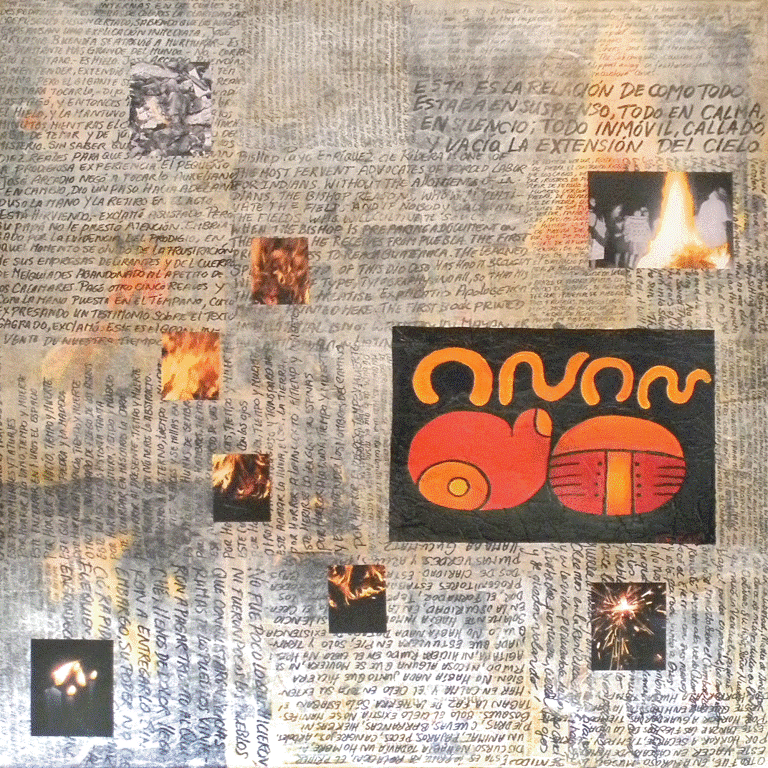
In 2006 I made this painting /collage for an exhibition we had in our gallery at the time, in Copán Ruinas. The canvas measures 135 x 135cm and consists of a thick layer of Honduran and Guatemalan newspaper, paint, photos and writing. The texts are from the Popol Vuh (the creation of the world) and several other Latin American novels and poems (by Gabriel García Márquez, Eduardo Galeano, Rubén Darío and others), all having to do with the creation of the world or the power of fire as an element of development as well as a destructive power. The work is a collaboration between Ronald Reinds, Lise Winters and me. Lise provided the photos of a bonfire in an indigenous community in Guatemala. Just below the middle of the right half, I left open a white rectangle on which Ronald projected his short 8mm film of himself reading a newspaper that burst into flames. We presented the work as an installation during the inauguration, with a mural of flames painted on the wall behind it and embers, ashes and burned paper underneath it.

When the exhibition made room for a new one, the painting ended up in my office. I never even tried to sell it because it is awkwardly big and heavy and besides, without Ronald’s projection, there was this graceless white rectangle on the right. For years I planned to “finish” the work, but never came up with the right solution. Once I thought of filling the space up with an assemblage of burned embers and cinders. I went out of the way to find pieces of the right size of burnt wood, but for some reason never got around to glue them on. 

A few days ago, the work appeared in my dream among many other completely inexplicable images. In my dream it was completely finished... The white of the rectangle was now black, and on it was a Maya glyph representing fire painted in bright yellow, orange and reds.

Perfect!

So, six years after creating this work, I finally finished it. It turned out exactly the way it looked like in my dream…

Ronald Reinds: http://www.beeldresearcher.tv/ 
Lise Winters  http://www.lisewinters.com/

Monday, May 23, 2011

13.0.0.0.0

This is a painting I recently finished (46 x 122cm, acrylics on canvas) based on the only known inscription of 13.0.0.0.0 (on Monument 6, Tortuguero, Mexico), the end of the long count Maya calendar, a date of much speculation (December 21 or 23, the end of the world!!!). Although I admit I choose this specific inscription because of the 2012 hype (and my wish to sell this work and being able to pay the rent!), more than anything I’m just intrigued by Maya glyphs. Not just their meaning, but especially their design, their aesthetic value. These glyphs here were carved in stone and are badly eroded by the weather, but once translated to the canvass in their original crisp shapes and then coloured in a bright palette, they get a whole different dimension. Maya goes Keith Haring!

Tuesday, March 30, 2010

Tourism for Dummies

It’s a good thing I have very little to do with tourists, because I’m way too undiplomatic, impatient and untactful to deal with them. Serve with a smile is definitely not my motto and I greatly admire all those tour guides who travel around with a herd of tourists for weeks on end without strangling one or two. At the same time I find them fascinating, tourists, especially if they travel in groups. As different as the people might be, as intelligently as the are individually and whatever the place they come from, there always seems to be the same psychological profile you can apply on each group. Completely politically incorrect and stereotypical, but here we go:
The Whiner: There’s always a big whiner in each group. The one that complains about the leg space in the bus; the food that is too spicy, too cold or too salty. Breakfast is either too early or too late and there’s always something wrong with the weather. The rest of the group initially listens and sympathetically nod their heads, but start to avoid the Whiner after a day or two.
The Know-It-All: The Know-It-All has worked hard to prepare for the trip: he or she knows all the facts, from the population of each country to its national gross product. The Know-It-All travels with a small library of guide books and often contradicts the tour guide when he says something a little different from the Lonely Planet. It is not uncommon for the Know-It-All to completely miss rare encounters and opportunities, because of course the Know-It-All has his head in the guide book when the quetzal bird flies. The Know-It-All is oftentimes disappointed that reality does not coincide with what the Guide Bible has to say.
The Know-It-Better: is not as prepared as the Know-It-All but tends to do the opposite of what the tour guide tells him to do. If the guide warns not to go to a specific area of town, you can be sure to find the Know-It-Better there. If the guide tells him to leave valuables at the hotel and not eat on the street, the Know-It-Better does exactly the opposite. It is no surprise the Know-It-Better is often the victim of robbery or food poisoning. That does occasionally shut him up.
Sue-You: Usually a middle-aged woman with a tendency to show that you can’t fool her and if you do, she’ll sue you. She daily threatens the guide (“If your company hears about you leaving us alone for five minutes!), the bus driver (“You better slow down, or else!”), the kids on the street (“I’ll tell your mother you’re here out on the street bothering innocent tourists!”), fellow travellers (“I have a right to have a room with a view too!”). Sue-You’s email address is immediately blocked by the rest of the group as soon as the trip is over and she is of course never invited to any reunion.
The Jolly Good Fellow: Everybody’s best friend, the Jolly Good Fellow is always in an annoyingly good mood, always ready to crack a joke and a big fan of practical jokes, especially of rather infantile ones such as fart cushions. Always in for a party and one last beer, his fellow travellers soon start feigning headaches when Jolly walks into the room.
Stingy: There’s always one person, man or woman, who counts and recounts every penny and constantly complains about the exchange rate. Stingy tips when the others are around, but has been seen to go back to tables to take away the tip again. When a bill needs to be paid for a group meal, she always tries to pay less than her share and justifies it that she drank “only half a glass of wine”.
Sorry: This man or woman attracts all the bad luck in the world but wouldn’t be able to live without it. Bad luck has become his meaning of life and he constantly apologizes for it and for everything else too, for that matter. Soft spoken with watery eyes, Sorry goes on for ever and ever. At first people around him do feel sorry for him, but soon they start avoiding his eyes and quickly after they try to avoid him all together.
The Leader of the Pack: Although guided by a professional, the Leader, often an energetic woman in her mid thirties, can do it all and just as well, if not better. The Leader regularly corrects the tour guide and it is known to have happened that the tour guide arrived at breakfast to find his group already gone. The Leader does not really know it better, but her strong leadership skills assure her a steady group of followers who just, well, follow her wherever she goes.
The Rebel: The trip was definitely not the Rebel’s idea but he was obliged to accompany a parent or spouse. The Rebel would have preferred to stay home and watch soccer. The Rebel is not interested in nature, culture or anythingelse, but has a great gift for finding bars that sell cheap beers in every town they visit.
The Pervert: Otherwise know as Peeping Tom, this is a guy you really want to steer away from. The tour guide has a hard time keeping him away from cute indigenous little girls selling on the streets.
Single: Undoubtly a woman, Single came on this trip with just one goal: to score. Unfortunately, most of the fellow travellers are married and worse, travelling with their spouses, which makes the chance of an affair during the trip almost nil. Single is thus obliged to find pleasure elsewhere, but a good number of waiters, bus drivers and local guides are usually willing to satisfy her.

And that’s why I don’t travel in groups…

I love Gringos!


Copán Ruinas is a famous tourist destination and thus frequently visited by people from all over the world although by some nationalities more than others. Besides tourists from Honduras and other parts of Central America, it’s probably mostly Americans who come through town. Being Dutch, I arrived here thirteen years ago with a typical European aversion against everything American, but after meeting so many I have to confess they’re not the worst tourists by far. Here my own personal top – 3 (and not necessarily in this order):
1: Israelis. You don’t see them too often, but if they’re in town, you’ll know it. They complain about everything, are stingy and often rude. I have nothing against Israelis in general and maybe it’s just the Israelis that visit Honduras that behave in obnoxious ways, but that’s how I feel about it. Thank goodness they don’t pick Copán Ruinas as a destination that often.
2: The Spanish. Again, 99.5% of the Spanish probably belong to the nicest people of the world, but the ones of that 0.5% that visit Copán could stay home for all I care. Besides their horrible dress code (they seem to favour gaudy wide sweat pants) they have this presumptuous arrogance for being European over American and speaking Spanish over any other language in the world. Since they do speak the same language as people in Honduras (well, sort of) they think they can’t be cheated and make sure as hell they won’t. They continuously haggle in a country where haggling is not common and are stingier than the stingiest Dutchmen.
3. The Dutch. What’s the matter with my fellow countrymen and women? When they go camping in France of hiking in the Ardennes, they just pack some comfortable clothes and that’s it. When the travel to Central America they make sure to wear a complete safari attire: shirts of lightweight-dry-quickly-no-sweat fabric; shoes meant to be comfortable but that fail their exam in appeal and oh yes, always those zip-off pants. Whenever I’m back in Holland for a visit I look out for signs that fashion has changed in my absence, but no, the khaki or army green safari outfit is solely used for travelling in the Tropics. Fine. It doesn’t bother me and it can lead to hysterically funny situations when groups of Dutchies visit some site and collectively decide to zip off their pants and thus become an instant attraction. Good, may the locals have some fun too.
The Dutch are famous for being stingy, but that is not what I think sets them apart so much (many other nationalities are stingy too, see point 1). Very typically Dutch is for them to completely ignore other Dutch tourists (except when they travel in packs, which they often do), whereas people from other countries tend to join tables to spend a jolly night together, because what a coincidence, they only live two states away from each other. Somehow the Dutch like to have this feeling they’re the first Dutch ever to set foot on a spot and don’t like to be confronted with countrymen who beat them to it. But worse than everything else is that the Dutch have an opinion about EVERYTHING. They can’t just sit, shut up and enjoy, no, everything has to be compared with something else and than be labelled and put in a box.
“I like the food here, but the food in that Korean restaurant where were last year was much better.”
“The ruins are okay here, but nothing compared to Machu Picchu.” (This often stated before they visit the ruins!)
“That waitress is not very friendly.” (Actually she is, but she just got a phone call that her brother’s best friend’s chicken was run over, for all I know!).
The Dutch know everything better because they are prepared, of course, because they read the guidebook, of course. Dear countrymen and women, throw away that book, look around and start enjoying what’s there in stead of complaining about what’s not!

No, give me the Americans: no nonsense, friendly and willing to pay the price whatever something costs. They have fun (admittedly loudly, every once in a while), they don’t complain too much and seem to thoroughly enjoy the short vacation periods they have. The Canadians are not too bad either, but they have this strange tendency to stick a Canadian flag on all their possessions in order not to be confused for an American. As if that matters. For the Hondurans we’re all Gringos…

Sunday, March 7, 2010

Auto-interview


Q: So Carin, just for introductions, tell me a bit about yourself.
A: Well, for starters, I normally really don’t do interviews. Never.
Q: Oh? Why not?
A: That’s personal.
Q: So why this interview, then?
A: Uh… Because you said that there would be a compensation available? Right? This is off the records, right?
Q: Of course it is. About a compensation, well, uh, yes, I actually am authorized to reimburse you your travel expenses.
A: Travel expenses? But where here in my living room!
Q: Well that saves us some expenses then, doesn’t it?
A: It also saves us time and trouble! This is it, no more questions!
Q: Oh, come on, just a few more? Now that I’m here anyway?
A: That’s a question. Two, actually. I said no.
Q: Oh. But that means I came all the way down here for nothing!
A: But you’ll get your travel expenses reimbursed. And a “compensation”, right?
Q: No, not if I don’t deliver this interview.
A: Oh, well.
Q: Oh come on, help me out here, a fellow artist and wanna-be writer, just like yourself.
A: That’ so?
Q: You tell me!?
A: Uh, no. I won’t.
Q: Okay, listen. What if I just tell you what information I have about you and you just say “yes” or “no”, depending whether you agree or not. Deal?
A: (Silence). Okay. Deal. Yes.
Q: Right. Let’s get started. So: you’re originally from Amsterdam, Holland, and you have been living in Honduras since 1997.
A: Yes.
Q: You’re an artist. Mostly painting, right?
A: Yes.
Q: And if I’m correct, you’re also the director of Arte Acción Copán Ruinas, an NGO that organizes cultural activities for children here in Copán.
A: That’s right. I mean: yes.
Q: So why did you start this Blog?
A: That’s not a yes or no question.
Q: Correct, it isn’t. Let me see. Uh, I see that you mostly write in English.
A: Yes.
Q: Why not in your mother tongue Dutch?
A: Because I don’t have Dutch spelling control on my computer. Damn it, that’s not a yes/no question!
Q: Yes it is!
A: No it isn’t!
Q: Is too!
A: You know what, this interview is over.
Q: No!
A: Yes!
Q: No!
A: Yes!