Living in Honduras and Guatemala is sometimes hard, mostly fun but never boring. Here some of my musings on life in this colourful part of the world where you can always expect the unexpected. Hence Serendipity, the gift of finding without seeking…

Monday, November 26, 2012

Fireworks


I love Honduras.
I really do.
But there are some things…

FIRECRACKERS!!!!!
I can so do without them…

Christmas is only a month away, so that means firecrackers all around. For those who do not know, in Honduras every event is celebrated with fireworks: weddings, birthdays, football victories and elections. Christmas is of course no exception. Or the month leading up to it, for that matter.

By no means do I mean to say that things in my home country Holland are better, because they’re not. But as far as laws, rules and ethics about fireworks are concerned, they are! If only people in Honduras would be a bit more aware of the dangers of fireworks, especially in the hands of young children.
From my own youth I remember how special it was when New Year came around (because in Holland fireworks are only permitted on New Year’s Eve!!!) and we were allowed to carefully and heavily supervised, light some kid-friendly, low-risk (and admittedly, quite boring) rockets. With cigarette butts, no lighters or matches allowed!!! (I guess up until somebody figured out that more people die of smoking related illnesses than fireworks, because I don’t think cigarettes are recommended any longer!).

But not in Honduras. Here, fireworks are a socially accepted toy for kids from age 2 and up. I’m not sure if there are any restrictions as to who can sell or buy, but if there are, laws are definitely not reinforced. It will be only a matter of days before fireworks will be sold on every street corner again, and don’t be surprised to find a baby napping under a table full of cohetes.  Small kids will buy cheap firecrackers while teenagers and fun loving adult men go for the heavy duty stuff. The day after, mostly after Christmas or New Year’s Eve, while parents sleep off their hangovers, kids are found roving around the street for bits and pieces of bangers, wheels and rockets that can still be lit up. And thus risk losing a hand or a third degree burn in a country where there are barely any clinics that can adequately treat burns.

So yes, I really hate firecrackers. They’re noisy, they’re dangerous, they scare the bejeezus out of me, they scare the animals and they are also very contaminating. I was hoping that the severe economic crisis here might affect the sales of fireworks, but unfortunately, no, it doesn’t sound like it…

Bang!

Tuesday, October 30, 2012

Remembering Mitch


The road to Santa Rita

While the aftermath of super storm Sandy still rages over the northeast of the US, it is hard not to remember Hurricane Mitch that made landfall in Honduras, today fourteen years ago.

It had rained a lot that year, 1998, and I remember that the day dawned, much the same as today, gloomy and grey. It drizzled during the rest of that Friday, a day much like any others, me working as a kindergarten teacher at the local bilingual school. The only break in the routine that week was that we had been collecting clothes for victims at the already flooded north coast.
That night I walked down from my house on the hill and I noticed that for the first time, the water was flowing downhill in little streams, in stead of being absorbed by the mud on the pathway. But at the time I didn’t realise the importance of that small occurrence.

I went out for dinner with friends and ended up in a bar. It was then that the news broke, little by little. Excited passer-by’s would inform us about a flooded house here, a broken fence there, a collapsed road elsewhere. In the meantime, it started to rain harder, although we never had the winds I always associated with a hurricane.

As the water rose in the valley around Copán Ruinas, we made our way to the Central Park to see if we could help somehow. An emergency centre had been set up in the town hall where people who had lost their home could find shelter and a meal. I somehow ended up in the one and only Red Cross ambulance in town and we made several trips to the outskirts of town, picking up people from their already flooded homes.
There was one family I had befriended that I was particularly worried about, because they lived in small house on the edge of a normally tiny creek that had turn into a wild roaring river. So I made arrangements for me to stay in the centre of town with a friend while taking advantage of the ambulance to drop the family off at my place. But when we went by, the mother refused to go, because there was some recently harvested corn in the house that she wouldn’t leave behind. For all I argued, the woman refused to go. 

The house next to the mentioned family's home
Hours later I tried again. Still the same. It was already nearing midnight and the situation got worse and worse. All the family’s neighbours had already been evacuated and the ground was trembling. A big chunk of the road had been swallowed by the creek, and the creek was hungry for more. I was standing there, arguing with the mother who still didn’t want to go. That’s when I made one of the most difficult decisions in my life. I concluded that I was probably smarter than the woman and that I would not under any circumstance want to risk the lives of these kids, so in order to keep them safe, I would just have to take the kids whether the mom agreed or not. So that’s what I did. I loaded the kids into the ambulance, literally plucked the baby out of the mother’s arms and off we went to my place, leaving a baffled mother behind. At home, I had already prepared some makeshift beds and a big pot of soup. I left the kids in the care of their oldest sisters and continued roaming the streets in the ambulance to se if any help was needed.

It was way past midnight when we made it back to the Central Park after our last trip. When we parked the ambulance, the mother of the kids was there, waiting for me. I was exhausted after the eventful night and an emotional scolding was the last thing I needed, but what could I do… But the woman wasn’t there to yell at me. On the contrary, she said that her whole house was shaking now, that her husband was really sick, and could we please pick him up and drop them off at my place??? So that’s what we did, even though the father’s sickness was of the self-inflicted kind, with the help of a bottle of guarro.

The bridge over the Copán River

The days to come were surreal. Copán was completely isolated. The roads were collapsed in both directions, so there was no way in or out. We didn’t have any Honduran TV channels at the time, let alone (online) newspapers, so we were quite oblivious to the disaster that had befallen ons other parts of the country.

Tragedy unites people and Hurricane Mitch was no exception. Although we were lucky in Copán to have very little fatalities (only one that I know of), there was plenty of damage. The bridge that crosses the Copán River was fine by itself, but the shores had been washed away on both sides and huge trees were stuck under the bridge, blocking the still ferocious flow of water. The bigger part of the valley had been flooded. Not so much by the river, but by the creek that couldn’t flow into the river anymore. Houses that had been flooded were filled to the roof with a heavy and sticky mud. Copán was a mess.
But without a plan or a need to be asked, everybody helped out wherever help was needed. Men risked their lives cutting trees in pieces that blocked the river. Others filled hundreds of sacks with sand or encaged in emergency repairs. The women set up a community kitchen in the town hall and fed all the people who were at work.

My friends and I did what we could too. Being tough girls, we helped cleaning up debris and filled up sandbags, much to the hilarity of local men. I helped to put a group of Dutch tourists to work who had been stuck in Copán. After a few complaints about their ruined vacation, they actually had the time of their life and I stayed in touch with some of them for years to come.

At night there was curfew. Not that it was needed in Copán, but it was a national state of emergency and curfew was declared in order to prevent looting in the big cities. Unfortunately, the police stationed in Copán at the time did little else than arresting people who broke curfew (including yours truly- many times!). We spent our nights at one of the bigger hotels in town where a friend worked as manager. Although deprived of national or international news, here we would watch our own efforts on local TV (filmed by Carlitos Álvarez) and drink the wine that otherwise no one else would drink anyway. Then we would go home, dodging the police, with buckets filled with water from the pool, because we had no running water at home. Miraculously enough, the electricity never failed. Not once!

Anxious hours turned into action-packed days and then into interesting weeks as life turned slowly back to normal. Dry-law and curfew became our biggest problems, even weeks after the hurricane. Mitch was a humongous disaster and did enormous damage in Honduras where thousands of people lost their lives. So it is with mixed feelings that I admit that in Copán – we actually had the time of our lives!

Road Santa Rota to Copán, Hotel Posada Real /Clarion on the background


Wednesday, October 24, 2012

The best kid in town


Hector & Josue

As a gringo or gringa living in Copán Ruinas you can’t avoid gathering around you a small but loyal crowd of kids, dogs and drunks. This crowd is not necessarily consistent throughout the years. Kids lose interest or grow up, dogs get run over and drunks get liver sclerosis. I’ve had plenty of sorts, but one kid stands out because he’s been hanging around since he was three years old, and today he turns thirteen. His name is Josue and he really is the best kid in town.

My friendship with Josuecito actually started because of his cousin Hector. Uncle, I should say, because although they’re about the same age, technically Hector is his uncle, him being the youngest of Josue’s father’s eleven brothers. (Seriously 12 sons, no daughters in that family!!!).
One day, during one of the Saturday art workshops I conducted for years, four year old Hector came up to me and asked if I could be his mom. I explained that that was a bit complicated, since he already had a mom, so we settled for me being his mom during the two hours of the weekly workshop, to both our satisfaction. Somehow that also meant that for the rest of his school career I provided him with school supplies, uniform and shoes.

I’m not sure when and where Josuecito actually came from, just that he started to come along with Hector, who was just a bit older, bigger, more assertive and streetwise. Josuecito mostly just followed Hector with a goofy smile on his face.
One day, Josue passed by my office on his way back from school, crying, while holding a piece of cloth against the back of his head. I called for him to come in and through the tears and sobs I found out he had fallen out of a tree, right on his head. The head injury was minor, just bloody, but one pupil seemed to be bigger than the other, and that was what worried me. A group of American nurses that happened to visit us at the time agreed and recommended to take the boy to a doctor. So I gave Josue some fresh gauze, took him by the hand and walked him home. I talked to his step mom and left some money to take him to the clinic. I didn’t realize I held Josue´s hand all the time until it was time to leave. We let go and he looked up to me with his gorgeous big eyes while flashing me the biggest smile ever, dimples deeply carved in his cheeks. It was then that I realized the kid was thrilled with all the fuzz. It probably was the most attention he ever got.

From that moment on Josue started to follow me around wherever I went. If I was working in my office, he would stand in a corner and just stare at me, that goofy smile on his face. I wasn’t sure what to do. Either the kid had suffered serious brain damage, or he was just a lovesick puppy.
It appeared to be the latter, because after a few weeks, it wore off and Josue started to talk and interact with the rest of my colleagues too. And for the years to come, he would come by my office almost daily for a quick hug. Quick enough not to be embarrassing, long enough to show we both care about each other. And of course I also provided him for years with school supplies, uniform and shoes.

Josue graduated from Grade 6 last year, but did not continue his studies. He says because he doesn’t want to (against fierce protest from my side), but I think it has to do with his dad, who is happy to have him as an assistant in his house painting job. And since I don’t conduct workshops anymore and Josue doesn’t need help with his homework, we needed a new excuse in order for us to stay in touch. So now Josue comes by once a week to sweep the street in front of my house (a chore I detest!) for which he receives 20 Lempiras (1dollar) a week, not bad for 15 minutes of work. So we’re both happy.

Sometimes Josue uses the money to buy food or snacks, but lately he kept it in a jar at my place so he could save up 100 Lempiras for a pair of badly needed shoes, even if 100 Lempiras doesn’t get you very far, shoe-wise. He was so happy two weeks ago when he finally reached his goal, but when I saw him last week, he was still walking around on his old and severely battered shoes. When I asked where the new ones were, he said he had to lend his dad the money. So far, he hasn’t been paid back yet.

Although turning thirteen today, Josue looks like he’s barely ten (that’s why I have him on vitamin pills now). But not only physically is he very young, I have rarely seen a kid so innocent and naïve in many ways. On the other hand, there’s no kid taking better care of his younger half brothers and sisters, or a boy who is so honest and kind. It hurts me to see how sick he often gets and the shitty home situation he has to live in, but Josue just smiles and carries on. And a smile from Josue will make your day!

So here’s to Josue, the best kid in town: happy birthday!
And now, let’s go shoe shopping!

Thursday, October 11, 2012

Forever waiting in line


If you’re slightly suicidal and you happen to be in Holland, then you might like the following experiment: Go to any regular, well visited stored, let’s say a bakery, and instead of carefully checking out who is last in line, you walk up front and loudly ask for a half a whole-grain, sliced, please.

It’s likely you’ll get killed.

Although not as polite or obsessed with queuing as the English, for the Dutch it is an unwritten rule that you never EVER go before your turn. NEVER!

So, being born and bred in Holland, during my first few months in Honduras I spent quite a bit of time waiting for my turn, until it finally dawned on me that there is no turn.
In the big cities it’s probably a whole different story (there you have such things as supermarkets), but in Copán most shopping is still done in small neighbourhood pulperías. With their own set of rules…

I’d go into a store and politely wait behind two women until the store owner would be so kind to pay me any attention. It’s not that the women were actually buying anything. Or at least not a lot. But there is always a whole lot of chatting and laughing going on. This would go on and on until I would get so frustrated that irritation would override my genetic politeness and I would interrupt the conversation and ask for a pack of toilet paper. Nothing would happen. At least nothing what I expected, such as killer looks, flying daggers, or a condescending up- turning of noses. Instead, the lady behind the counter would grab a pack of toilet paper from a shelf behind her, tell me the price, accept my money, give me change and all of this without even the slightest pause in her conversation!

It took a while, but I finally learned that you don’t go shopping to buy stuff, (that’s sort of collateral damage), but to see what‘s going on in the world. You go to the store to discuss the weather or the price of eggs and of course to hear the very latest gossip. Shopping is a social event that should not be hurried or interrupted. It’s an almost sacred ceremonial exchange of information that is not disturbed by other customers, whining children or salesmen.
If you actually need to buy something, you send your kid to the store.

This way of shopping, as much as I’ve come to respect it, is really not my thing. But that’s fine, it’s just not for everybody. Now, years later, I have shopping in a hurry down to an art. I walk into a store, ignore everybody else, ask for what I want and am attended instantly, happily exiting the store seconds later with my purchase.
But every once in a while, while I’m being attended, someone else comes up from behind and will yell out whatever he or she wants, while it is still my turn!!! That’s when the Dutch part of me awakes like an angry orange lion. I’ll turn around and snarl and the intruder.

Hey you! Wait for your turn!

I can’t help it. Even though I know very well that the response will be a blank stare.

Sunday, October 7, 2012

Everybody lies


Let me get this straight. I am from Holland. Worse even, I am from Amsterdam. That means that I’m stereotypically very direct, straight-forward, undiplomatic and sarcastic, the combination of it often confused with being brutally honest. It’s not that I never tell a lie (All the time! It’s just that I call it “art” of fiction”, hahaha!), but it is not in our nature to lie about just everything. Because it’s just not necessary and often not very effective, and if we dutchies are something else too, it’s effective.

But in Honduras, stereotypically of course, everybody lies. I guess Hondurans are eager to please and rather send you in the wrong direction than actually confessing they don’t know the place you’re asking about. When you ask when something will be fixed, you’ll often get the famous mañana (tomorrow) for an answer, which means anything between “tomorrow” (however unlikely) to “next week” (way more realistic). Vague promises, lame excuses, evading answers and downright lies are much more common than an honest “I don’t know”, or, God forbid, “no” for an answer. A friend once told me that the tour guides at the archaeological park were taught never to admit they didn’t know something, but rather make something up, as to look professional. At schools too, a wrong answer is better than an “I don’t know”.
In Honduras you just never say no.

I’ve been living here long enough to know that some things will never change, but the fact that they can’t even be slightly altered is sometimes particularly frustrating.
Last week I finally got a complete set of ink cartridges for my printer delivered, which took almost two weeks and a lot of phone calls and visits to the store. When I bought my printer a few months ago, I was assured that they would always have ink in stock, which was one of the main reasons to buy that particular printer. It was, of course, a lie. But no problem, the ink could be sent that same day from San Pedro Sula and would arrive in the afternoon. Right. Day after day went by, with all possible excuse, but no ink. I pleaded the girl to tell me the truth rather than give me yet another implausible explanation, so at least I could plan my work around the absence of ink, or find my own way to get the bloody cartridges into my possession, but she assured me on a daily basis that the cartridges were on their way. After two weeks of having my professional life on hold, for no reason but the lack of truth, I finally had the whole set complete.

But even this sort of lying, as annoying as it is, I can sort of understand. It’s about not wanting to disappoint a customer, even if that’s exactly what happens. But why lie for no reason whatsoever?  I asked someone about his family the other day, and this guy told me he only had three sisters. A little further on in the conversation, he mentioned his brother.
“I thought you said you only have sisters?” I asked, confused.
“No, I didn’t,” was his answer.
????
This sort of stuff happens all too often, and it’s not because of my Spanish!!!

So there’s lying in to hide a hurtful truth, lying to gain profit, lying to impress and lying to avoid responsibility. I understand all that. But the lying for the sake of lying, why????
But then again, lying your way around and getting away with it?
I’m learning and loving it!

Saturday, September 22, 2012

English Spoked

A sign I once saw that said "English spoked" came to mind when I found this flyer. Extraordinary beautiful in a mind-boggling sort of way. 


Thursday, September 13, 2012

Spanglish


I love Spanglish.

I’m glad many of my friends are bilingual so slipping from one language into the other, often in mid sentence, is no problem. I admit that picking the first word that comes to mind no matter the language, does tend to make you a bit lazy. At the same time, you also tend to pick the words that best describe what you want to express, so effective it is. I also love the English words that have “contaminated” proper Honduran Spanish (if such thing exists) and that have started living a life of their own. Cheque, for example. No Copaneco can come by without using that word at least once an hour. I guess it comes from the English word check (as in “done”), but here it means something like “okay”, and is often followed by leque. Cheque leque. I’m serious!

Another favourite of mine is wachimón (watchman or guard). Tools and car parts have terrific “spanishized” names (mofles, cloch, rines), not to mention the social media such as Feisbuh, that for some odd reason in Copán is referred to as Ceibo.

I once had a conversation with someone from Guatemala about the influence of English on Spanish spoken in Central America. I told him about the emergency I had one time with the breaker in my house, and that I’d realized I didn’t know the Spanish word for it. It happened to be bréquer. To which my Guatemalan friend said he could do better: in Guatemala it’s called flip-on!

There are so many great examples, but I think some of the best and “purest” completely Spanglish sentences are the following:
Voy shopping.
Qué nice!

Hasta later!

Monday, September 3, 2012

Rules of the Wild


Years ago, a friend lent me a book called Rules of the Wild*, by Francesca Marciano. She said I had to read it, that it was so us, so Copán.

Yesterday I cleaned out my closet because the rain had found its way into my bookshelves, and among tons of usable crap I found the copy I once made of the first page of Rules of the Wild. The first sentence struck me as much as it did about ten years ago, and is still so true:

            In a way everything here is always second hand.

The whole page actually is. I never read a better description of what livening as a foreigner in Copán is like, so hereby the first few paragraphs of Rules of the Wild:


In a way everything here is always second hand.
You will inherit a car from someone who has decided to leave the country, which you will then sell to one of your friends. You will move into a new house where you have already been when someone else lived there and had great parties at which you got incredibly drunk, and someone you know will move in when you decide to move out. You will make love to someone who has slept with all your friends.
There will never be anything brand-new in your life.
It’s a big flea market; sometimes we come to sell and sometimes to buy. When you first came here you felt fresh and new, everybody around you was vibrant, full of attention, you couldn’t imagine ever getting used to this place. It felt so foreign and inscrutable. You so much wanted to be part of it, to conquer it, survive it, put your flag up, and you longed for that feeling of estrangement to vanish. You wished you could press a button and feel like you had been here all your life, knew all the roads, the shops, the mechanics, the tricks, the names of each animal and indigenous tree. You hated the idea of being foreign, wanted to blend in like a chameleon, join the group and be accepted for good. Didn’t want to be investigated. Your past had no meaning; you only cared about the future. Obviously, you were mad to think you could get away without paying the price.

Interestingly enough, this isn’t about Copán, but about Nairobi, Kenya. So either way we gringo’s are all the same, or the world is just a very small place. Or maybe it isn’t about a place at all. Which reminds me of a remark made by the same friend who lent me the book:

Copán is a state of mind.

So true.

This one is, of course, for Flavia…

* Rules of the Wild, Francesca Marciano, Vintage, 1999  Great book, buy it!

Saturday, August 25, 2012

Honduran Heroes


Heroes are important. Whether they‘re pop stars, astronauts, Nobel Prize winners or athletes, they can lift up the spirit of a whole nation. Just see how heart-warming the welcome race walker Erick Barrando received in Guatemala after winning a silver medal at the Olympics!

Unfortunately, Honduras doesn’t have a Shakira, Ronaldinho, Che Guevara, Vargas Llosa or Ricky Martin. Not that Honduras doesn’t have talent, it’s just that so far there hasn’t been an musician, actress, politician (not even a bad one!) or artist that has put Honduras on the map yet.

But heroes there are plenty, even though they’re mostly busy being invisible and unappreciated.

My greatest heroes here are the people from the ENEE, the national electricity company. Not the people who run that miserable enterprise, but the people who fix all the problems. Millions of them!

As soon as a tropical storm hits, you can be sure a light post will fall down somewhere, a cable will break or a transformator will be hit by lightning. To the ENEE people the ungrateful task to jump in the car, find the fault (anywhere between Copán and La Entrada, 60km from here) and fix it. Often in the rain and wind, at any possible hour, but of course usually in the pitch black of a stormy night. They climb posts in rain and hail, risk their lives and sometimes get badly hurt, such as what happened to Moncho a few months ago, who got a shock, fell down but saved his own life by making a big cut in his hand so the electricity surge could leave his body (as his aunt explained me). Moncho was happy to make it, but is still limping badly. Oh, and if the work isn’t dangerous and challenging enough, they have to deal with dozens of calls from copanecos to their cell phones who want to know why there is no luz and when it will be back on.

These men are true heroes and I hope they realize how much I appreciate the job they do.
Chapeau!


Monday, August 13, 2012

Despedidas


For lack of a better word, this post is titled “despedidas”. Can’t think of a good translation.  Farewell party? Nah, too archaic. Send-off? Too military… Goodbye ceremony? Not funky enough. So, despedida it is.

I consider myself a bit of an expert on despedidas. After almost sixteen years in Honduras, I have organized many and have been to many more. In Copán Ruinas, despedidas are frequent, because there’re so many people who come here to live for longer or shorter periods and for many different reasons. There are the Mayatan Bilingual School teachers (who look younger every year, but that’s what we say every year), the archaeologists, Spanish students, volunteers, aid workers, missionaries and a handful of lost people who’ll be lost forever, unrelated to wherever they are. Some you barely get to know, others become close friends. And of course, the closer friends they become, the harder it is when they leave.

I actually don’t like despedidas at all, because I hate to say goodbye. But, if you have to, you might as well do it in such a way you’ll never forget. Or at least as long as it takes to recover from the hangover.  

Some of our despedidas were legend. Remember the Oy Awards for Sarah? The red carpet, a real TV reporter and awards for the best street dog, chef, drama queen and most desired bachelor (for which I was nominated, but lost it to Lloyd, dammit!). That was the queen of all despedidas. But there was also a good one for Marcus from Denmark with a Smurf theme, including Smurf porn, if I remember correctly. Quincy’s despedida lasted a whole month and left everybody completely exhausted (and dehydrated and poor). I remember despedidas in Tunkul with René and Lisa singing a duet while Aidan was playing leprechaun on the roof beams. But mostly I remember nothing at all, which probably has to do with the generous amounts of alcohol that are usually present at despedidas.

About two weeks ago we celebrated the despedida of our friend Argi. After seven years of friendship, that was a tough one. A loooong one too. The party was great, the hangover monumental, so it was a good idea that Argi had decided to plan a whole day for recovery before taking off. The day she actually left, we met for breakfast with a few friends, as an after-despedida, and then escorted her to the bus station. It was really not a lot of fun. Sitting there waiting fort the bus to leave, trying not to tear up. What’s there to say when so little time is left and all has been said? Finally the bus was about the leave and we said our final goodbyes. (Actually, we didn’t because we decided that was too painful. We said “hasta luego”).

I left the bus station with Kristin and Lizzette, feeling empty and overwhelmed at the same time. We got into a moto-taxi. We avoided looking at each other, because it was pretty obvious that all three of us would start bawling if we did. Then, as the taxi drove off, Lizzette started singing “Kum Bay Yah My Lord, Kum Ba Yah”. Kristin and I immediately joined in and there we went:

Kum Bay Yah My Lord, Kum Ba Yah. Kum Bay Yah My Lord, KUM BA YAH!!!!

The taxi driver watched us quite alarmed trough his rear view mirror as we passed the cantinas, up the hill, while singing on top of our lungs.

Kum Bay Yah My Lord, Kum Ba Yah
Oh My Lord, Kum Ba Yah…

And somehow, that really made me feel better…


(There you go Argi, this one’s for you! You’d never have guessed you were “gospeled” out of Copán!!!)

Sunday, August 12, 2012

What’s the noise all about?


I don’t know whether it has ever been scientifically researched, but I wouldn’t be surprised if Hondurans are the loudest people on Earth.
A Honduran event without a lot of noise is as unlikely as a Honduran meal without tortillas. Hondurans really like to indulge in making a racket. The more the merrier!

For starters, there’s fireworks for every special occasion (Christmas, Easter, Independence Day, New Year, among others). And I’m not talking about a beautiful fireworks display, but heavy duty bombs that rattle the windows, make the dog dive under the bed and even get haughty frowns from my cats. At dawn, of course. Or actually, they start at dawn, but from there on there’s no real pattern.

Birthdays are preferably celebrated through serenades at 5am. Loud ones, too. And in order to sell a product, you need a whole wall of speakers in front of your business, preferably with heavily distorted punta or reggaeton. This makes shopping in malls an unbearable experience and unfortunately this trend has made it all the way to the previously (relatively) quiet town of Copán Ruinas.
I just crossed the central park and it completely baffles me how people can actually stand it without suffering from noise induced hearing loss. (Or maybe they’re already deaf and that’s why they turn up the volume). On each corner people are selling one thing or another through their amplifiers, backed up by a few businesses in adjoining streets that also loudly announce their products, because it is weekend and the neighbours do it, so they do it too. Does this really work? What happened to a gentle and generic elevator tune on the background? For me it definitely doesn’t work. I go a mile out of my way to shop somewhere in silence. (Which means I’ll probably starve to death very soon.).

I lost count how many times I moved because of Religious Noise Pollution: a church in the neighbourhood is normally very tolerable until the congregation grows and enough money had been raised to buy a sound system, usually with more speakers than church members.

Oh, and there’s the honking.

And parents yelling at their children.

Radios and TVs that are perpetually turned on. So what if you can’t hear yours because of your neighbour’s, you just turn your own volume up a bit!

Indecently loud cell phone ring tones.

My neighbours’ dog tied up on the patio that barks and cries all night long. (Seriously, am I the only one to be bothered??)

The rooster on the same patio. (I don’t think they even have chickens. So what’s the rooster all about?)

And now, to make matters much worse, there’re the primary elections that instead of a battle of visions seems to have become the Battle of Noise. The Liberals are loud, so the Nationalists need to be louder, and so on…

Am I overly sound sensitive here? Or just not Honduran enough?

I do have a theory about this: I grew up in an apartment above a carpentry workshop and until this day I find the hammering and whining of a chainsaw a comforting sound. As a matter of fact, I find it so familiar, and soothing, I sleep like a baby right through it. So what if the sound you grow up with is what comforts you??? That would explain why Hondurans get so uncomfortable when there’s no noise around. Have you noticed how they produce incredible amounts of decibels wherever silence might reign? On beaches, picnic areas, parks: open the door of your car and crank up the volume!
So to go back to my theory, it would mean that Hondurans need noise in order to feel comfortable, because that was the environment of their early childhood. It also means there is no solution to the problem unless we can create a new generation of children that will grow up in silence (or at least a no-noisy ambience). But how to do that? Maybe get Coca-Cola involved with a campaign aimed at young parents: The Silent Generation…

As for now, it has started to rain, so at least the sound of rain hitting the zinc roof drowns out the noise of the rest of the world. It also means the power will go out shortly. But that is a whole different theme…


Tuesday, August 7, 2012

The Wrong Gringa


Even though I’m a starving artist who’s behind on the rent and hasn’t paid this month’s electricity bill yet, that’s not how local people see me and I don’t think that will ever change.

The other day my roommate told me somebody was looking for me. A woman with a sick child. 
Ay no, not again.
I asked my roommate why she couldn’t have said I wasn’t home, but she just shrugged and locked herself in her room.
So I went downstairs, and indeed, there was a woman with a miserable looking boy standing on my porch. I asked what the problem was and the woman in question said the boy had diarrhea, was severely dehydrated and that there was a strike at the health centre. And that she knew that I am such a persona alegre (Merry??? Me????) and that’s why she came to ask for a ayudita.

Sigh.
Okay, let me see what I can do.

So I went back upstairs, got my purse and took out a little from an already alarmingly small amount of money.
Back down stairs I handed the woman my miserable contribution, for which she thanked me profusely. I was about to close the door when the woman indicated that she wanted to ask me a question.
Sure…
“Are you that woman from the US who gives out loans, by any chance???”
“No, I am not. I mean, I am not from the US and I don’t give out loans.”
“Oh!” The woman exclaimed, and started giggling. “Then you are the wrong gringa!!!”
“Oh,” I said. “In that case, can I have my money back?”
That caused another bout of laughter.
“You are a very, very funny person!” the woman said, still giggling while she dragged her sick kid off my porch.


Thursday, June 28, 2012

Nature’s force


It has been unbearably hot for days now with temperatures in the 30°C and a most oppressing humidity of around 70%. It constantly feels like a major storm is about to break.
Yesterday afternoon it finally did.

It started as a huge rainstorm that makes you wonder if you have ever seen anything like it, and then all of a sudden it intensified and it started raining twice as hard! Then a vicious wind swept horizontal sheets or rain over rooftops, just before marble sized hail started bombarding doors and windows. By then the electricity had already been cut off (of course). I closed doors and windows because water started pouring in from everywhere in my second floor apartment: through closed windows, underneath doors and from numerous leaks in the roof I didn’t know were there. Windows were shaking, the roof was trembling and I could hear the zinc laminas on my neighbour’s roof banging. Lightning brightened the dark afternoon sky. It was quite scary… I felt I had to do something, so I locked my doors, as if that would keep the storm out. (Very smart, a friend remarked later, in case something would have happened, people wouldn’t have been able to enter my apartment!)

And then… It was over. The whole ordeal didn’t last more than 20 minutes. Of course it took hours to sweep the water out and clean up the layer of sand and grit that fell down from the ceiling. But I guess I was lucky. My next door neighbour’s entire roof was blown off and there were fallen trees and branches everywhere. I even heard that the tarp over the hieroglyphic stairway in the archaeological park was blown away, although no confirmation on that yet. But when I called a friend in the mountains to ask if there was much damage, she said there was none. It had rained hard, yes, but no hurricane winds as we had downtown.

Today people are still busy cleaning up and fixing things. But no matter how well you prepare, nature is always able to blow your socks off. Sometimes quite literally!

Monday, June 25, 2012

Culture Shock


I just came back from a two-week trip to Spain and as usually when travelling, that’s when the cultural differences hit you in the face. Everything that has become normal after living in Honduras for fifteen years becomes exotic again, but also strangely familiar to come back to. I’ve been thinking long and hard about what in my opinion are the biggest cultural differences, and here is my top 3:

1. Toilet paper disposal
In Honduras we don’t flush toilet paper, but throw it in a waste basket, so the pipes won’t get clogged. For some reason the system wasn’t build to support the disposal of toilet paper. This is not a myth nor a joke, as anyone can tell you who has had a bunged up toilet. Thing is, you get used to it. Up to such an extent that once elsewhere, you keep looking for the wastebasket. And just when you get used to the flushing, it’s time to go back and getting used all over again NOT to throw the paper in the toilet.

2. Greetings
If you meet someone new in Honduras in a more or less formal situation, you shake hands. On less formal occasions (or with people from the big cities) you press your right cheek against theirs, while making a kissing sound with your lips. Depending on whether you know and/or like the person, this gesture is completed by fake smile or a brief hug with your right hand on the other person back. But all in all, we’re not very touchy-touchy here.
Now, then in Spain! Your great everybody (but the mailman, I guess) with a kiss on each cheek. And there’s also a lot of Spanish versions of “sweetie”, “my love” “my dear” and “cutie pie” that we’re not used to here in the Honduran country side. Very different indeed, and even a bit intimidating!}

3. The language
If you think that in Honduras and Spain we speak the same language you’re wrong, because we don’t. In Honduras we speak Spanish. In Spain they speak Castellano. And the differences go way beyond vocabulary. La gorra in Honduras is el gorro in Spain. “Coger” means to take, in all its translations, but not “to fuck”, as we tend to interpret it on this side of the pond. There are a lot of words anyway that are very normal in Spain but quite spicy in Latin America. So communication is sometimes slightly difficult, but more often very funny.

I love those small differences between one place and the other. They make every place unique and special, even if they make you feel slightly uncomfortable. The world wouldn’t be the same without them. Although… maybe the world could benefit from a universal system for toilet paper disposal???


Tuesday, May 15, 2012

Pestering Heat


The months of April and May linger towards the beginning of the rainy season, and are not my favourites. I prefer the temperature of June, the morning mists of November, the clear blue sky of December, even the crispy chill of January. But towards the end of April, the mountains turn yellow, the roads dusty and the sky a nasty grey-yellow, charged with ashes from slash-and-burn all through the valley. While the temperature rises and the air gets drier every day, another nuisance appears: ticks! The tiny brown-red bastards love my dog and me even more! And in spite of the expensive Frontline and cheap home remedies such as a few drops of oil in the neck, I’m picking ticks off my dog every day. Yuck!

This year, my not-so-favourite-months had another surprise in store. On April 22 my dog turned 10. Pretty old for a medium sized black lab. So I was quite surprised when not a week later, my dog, Luca, turned out to be in the heat! Visions of Luca’s last heat entered my mind, my house barricaded but nonetheless besieged and peed on by an army of male, horny dogs. Not he prettiest ones either!

Now, Luca has been spayed when she was about a year old, so she can’t have puppies., Unfortunately, the vet at the time didn’t do a hysterectomy, just “tied her tubes”, so all these years, until 2010, Luca has been in the heat once or twice a year, or, if lucky and I caught it on time, I’d give her a shot to prevent the heat from developing any further.

This time, our friend the vet from Guatemala happened to be in town, so I asked him whether I should inject her again. He said I shouldn’t. At Luca’s age, the symptoms would be barely noticeable.
Hah!
That was the understatement of the century. Luca was as HOT as never before. But she could wiggle her butt or lift her tail all she wanted, most canine candidates were not interested in her. At least, not the big ones, I had already noticed that smaller dogs, of the lapdog variety, were very much into her. And since lapdogs are a bit of a trend in Copán, there’re unfortunately plenty around. They would follow us on our long hikes and I would even feel sorry for the animals and their short legs, and afraid they might get run over. That was then.

About a week later, I was about to strangle them. Two in specific. Tiny little monsters with a terrific sense of smell that made my life a living hell. I couldn’t go out with Luca anymore, because she got jumped upon the minute we set a foot on the street. Not very handy when your dog is trained not to do her necessities on the patio. At night I couldn’t sleep, because the dogs were outside my neighbour’s door, whose patio borders mine, wailing all night and scratching the door. The second night, one of dogs learned how to push open the wooden door, through the iron gate that protects it! One night later and the dog, by that time skinnier, I guess, because of days without food, fit through the gate and started his hammock on my neighbour’s patio. He scratched his way halfway through the wooden partition that divided the patios and terrorized my cats. He would bite my neighbour whenever she tried to kick him out and couldn’t care less if I threw a bucket of water on him, about four times every night. In the meantime, Luca wouldn’t eat, sleep, pee or poo, she was just on the alert 24hrs a day, constantly tried to rape my cats and wanted to be cuddled a lot. Especially near her tail. Right.
After a week I was sleep deprived, frustrated, cranky, on the edge and hallucinating with cruel visions of all sorts of lapdog torture. Of torturing their owners too, who don’t care where their dogs hang out, or vaccinate or neuter them.
Heat and more heat and ticks, what a hell!

And then, all of a sudden it was over. Yesterday was the first day the tiny furry ogres where no where to seen. Today it started to rain and the temperature dropped noticeably.
It almost feels like heaven…

Saturday, May 12, 2012

Mother’s Day


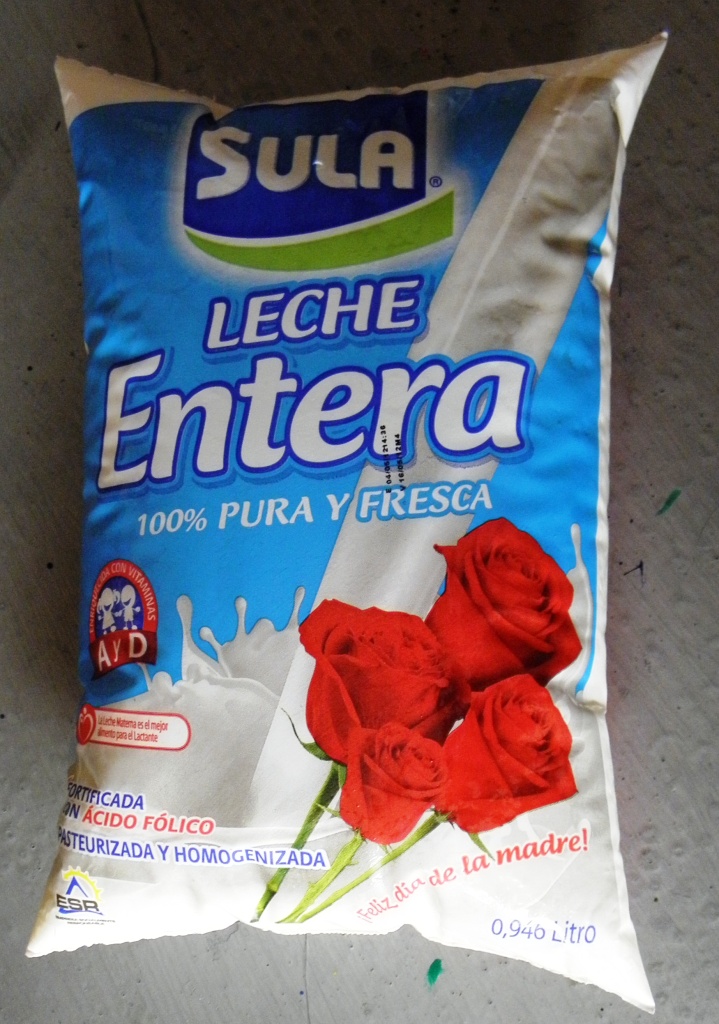
Even the milk company is cashing in on Mother's Day
Honduras is turning red. There’s nothing bloody or political about it, it’s Mother’s Day Frenzy. Stores exhibit special displays overloaded with kitchen supplies, frolic but trivial thingies, and artificial roses in all colours and sizes, red being the predominant colour. The local warehouse stays open late, hoping to catch last minute buyers with deafening music and a 30% discount. The park is filled with women selling flowers while evangelists are preparing an on-stage and very loud tribute to mothers and Jesus. Kids haven’t received any classes the last few days, being too busy making Mother’s Day gifts, memorizing Mother’s day poems, dancing Mother’s Day dances and singing Mother’s Day songs. Restaurants have special offers for Mamá and there’s not a single business in town that hasn’t paid the cable company to put a cheesy ad on TV, wishing Mamá a Felíz Día de la Madre.

Expectations are high, tomorrow is the day.

Kids will happily give their handmade flower vase or foam picture frame to Mamá, before starting to whine for breakfast. Husbands will take Mamá out for lunch or dinner and will feel proud and good about themselves for the rest of the year, being such considerate and sensitive husbands.

On Monday morning, everything is back to normal, except for some withering roses in hand painted flower vases.

I think every Sunday should me Mother’s Day in Honduras. Maybe without the loud music and tacky presents, but a weekly break fore Mamá from all her duties and responsibilities, yes.
If any one deserves it, it’s the Honduran Mother.

I think Mothers rock all over the planet, but I happen to live in Honduras and I know for a fact that this country wouldn’t be what it is without the mothers. Women know very well that Honduras is an unambiguously matriarchal society, even if that’s something men don’t seem to realize or simply ignore. Seriously, all of Honduras’ main problems (corruption, violence narcotrafficking, abuse of power, waste of natural resources): caused by men.
In the meantime, the women, whether abandoned by their husband or not, keep on taking care of their kids, making somehow three meals a day, doing laundry and cleaning the house, often with a fulltime job on the side. If tomorrow mysteriously all women would disappear in thin air, this country would fall on its butt and would never be able to stand up again. However, if all men would disappear… Now, that would be interesting!

So, here’s to all you strong, beautiful, terrific Honduran mothers. Have a great day tomorrow! You women make the world go round!

Oh, and now we’re at it…. Can you please teach your kids not to throw trash on the street? And can you raise your sons to be just a tiny bit less macho???

Thanks. 

Monday, April 30, 2012

Things I truly love in Honduras


For some reason it is easier to write about things that bother or annoy me, than things I love. I wonder if it’s just me, or a general thing. And if it works this way with writing, wouldn’t it be the same in relationships, just to name something? I mean, after a while you don’t see that that cute hunk anymore, but a bulk in bed who doesn’t throw his dirty socks in the hamper, right? I feel my relationship with Honduras has sunk to that level and I need to remind me every once in a while why I fell in love with Honduras in the first place.

So here’s to things I absolutely love, adore and worship in Honduras.

Avocados. Oooohhh, do I love avocados!!!! I think it’s the most perfect fruit (or vegetable, or whatever you want to call it) that nature has to offer. And especially the avocados in Honduras! Nothing to do with the rock-hard and very expensive spray-painted crap you buy back home in the supermarket and that take days in ripening. No, the best are the avocados that fall out of the tree in your back yard and that are so tasty and creamy… Guacamole is terrific, avocado in soup is also great, but I think the very best is just to cut one in half, sprinkle some salt and lime juice on both halves and spoon it out. Also great for facemask or hair packs! Can’t wait till avocado season in this part of the country (July) when they’re so nice and ripe and cheap, you can eat yourself sick of them.

In April, just when you think the weather can’t get any hotter, dryer and more oppressing, it’s watermelon season. Yeah! There’re pick-up trucks on each street corner loaded with watermelons for as cheap as 1 Euro. Keep it in the fridge for a few hours and then just cut off a big chunk when you’re all sweaty and thirsty…It never ceases to amaze me how all that water actually got into the melon… For those who are interested in watermelon with piquete; make a hole in your watermelon, pour vodka in it (or tequila or rum or whatever liquor in whatever quantity), put it in the fridge for a few hours, and there you go. Not very suitable for young children.

Number three on my list: Baleadas!!!! Those who live(d) in Honduras know what I’m talking about and probably wholeheartedly agree. For those who have never had the pleasure of eating one, you don’t know what you’re missing… A baleada (“shot one”) is a folded flour tortilla filled with refried beans, cheese and cream. Very typical Honduran food in the sense that it’s mostly starch and fat, but oh, how delicious! There’re many variations (baleadas with scrambles eggs, chicken, chilli etc.), but the plain old baleada sencilla is for me the best of the best. You can even find baleada on Wikipedia! (Where you can learn that the name “baleada” either comes from a  woman who used to sell baleadas who was shot in her leg, or from the fact that the beans (if not refried) tend to “shoot” out of the tortilla on one end while talking a bite out of the other end. Whatever the case, the baleada is one of Honduras’ greatest inventions.)

Gotta go, it’s baleada-time.

To be continued.